

This guide shows you how to deploy and configure a performance-optimized Red Hat Enterprise Linux (RHEL) high-availability (HA) cluster for an SAP HANA scale-up system on Google Cloud.
This guide uses the Terraform configuration provided by Google Cloud to deploy the Google Cloud resources for running the SAP HANA scale-up HA system such that the system satisfies SAP supportability requirements and conforms to best practices.
This guide is intended for advanced SAP HANA users who are familiar with Linux HA configurations for SAP HANA.
The system that this guide deploys
By following this guide, you deploy an SAP HANA scale-up system in an HA cluster on RHEL on Google Cloud that includes the following resources:
- A primary and secondary site, each containing an instance of SAP HANA, hosted on a Compute Engine instance. These sites are deployed in different zones, but in the same region.
- SAP-certified SSD-based Persistent Disk or Hyperdisk volumes for the SAP HANA data and log volumes, which are attached to the compute instances.
- Synchronous replication between the primary and secondary sites.
- A Pacemaker-managed HA cluster that includes the following:
- The RHEL high-availability setup.
- A fencing mechanism. You can choose to implement SBD-based fencing in the cluster.
- A virtual IP (VIP) that uses a Layer 4 TCP internal load balancer
implementation that includes the following:
- An internal passthrough Network Load Balancer to reroute traffic in the HA cluster in the event of a failure.
- A reservation of the IP address that you select for the VIP.
- Two Compute Engine instance groups.
- A Compute Engine health check.
This guide does not include information about deploying SAP NetWeaver.
Architecture diagram
The following tabs show the architecture diagram of the system that this guide helps you deploy:
For fence_gce based fencing
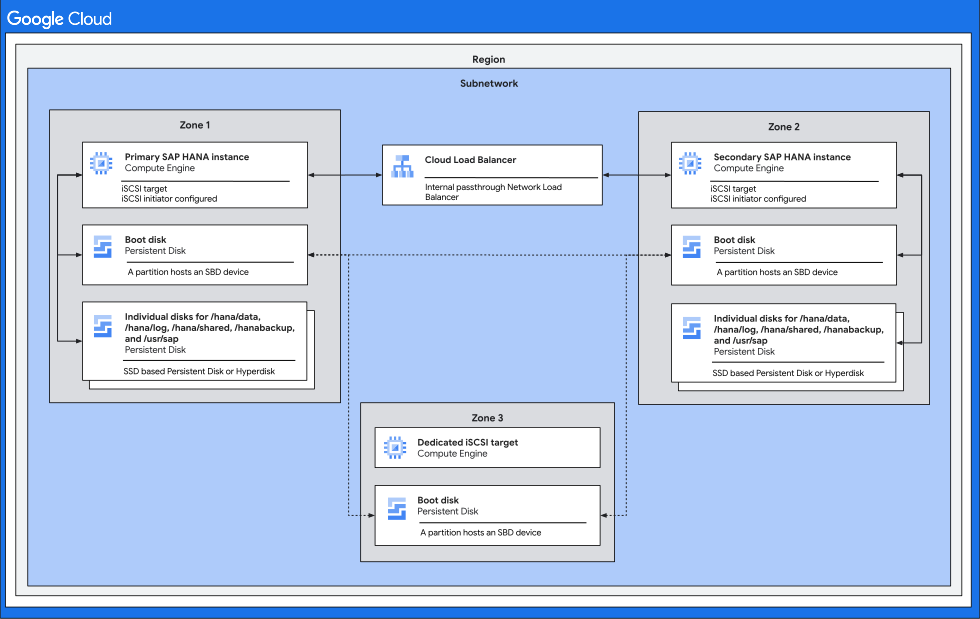
The following architecture diagram shows the resources deployed in an SAP HANA
scale-up HA system when you opt to use the fence_gce agent based fencing
mechanism:

For SBD based fencing
The following architecture diagram shows the resources deployed in an SAP HANA scale-up HA system when you opt to use SBD-based fencing:
Before you begin
Before you deploy the SAP HANA scale-up HA system on RHEL, make sure that the following prerequisites are met:
- You have read the SAP HANA planning guide and the SAP HANA high-availability planning guide.
- You or your organization has a Google Cloud account and have created a Google Cloud project for the SAP HANA deployment. For information about how to create Google Cloud accounts and projects, see Set up your Google account.
If you require your SAP workload to run in compliance with data residency, access control, support personnel, or regulatory requirements, then you must create the required Assured Workloads folder. For more information, see Compliance and sovereign controls for SAP on Google Cloud.
If OS login is enabled in your project metadata, you need to disable OS login temporarily until your deployment is complete. For deployment purposes, this procedure configures SSH keys in instance metadata. When OS login is enabled, metadata-based SSH key configurations are disabled, and this deployment fails. After deployment is complete, you can enable OS login again.
For more information, see:
If you are using VPC internal DNS, then the value of the
vmDnsSettingvariable in your project metadata must either beGlobalOnlyorZonalPreferredto enable the resolution of the node names across zones. The default setting ofvmDnsSettingisZonalOnly. For more information, see:
Setting up your Google account
A Google account is required to work with Google Cloud.
- Sign up for a Google account if you don't already have one.
- (Optional) If you require your SAP workload to run in compliance with data residency, access control, support personnel, or regulatory requirements, then you must create the required Assured Workloads folder. For more information, see Compliance and sovereign controls for SAP on Google Cloud.
- Log in to the Google Cloud console, and create a new project.
- Enable your billing account.
- Configure SSH keys so that you are able to use them to SSH into your Compute Engine VM instances. Use the Google Cloud CLI to create a new SSH key.
- Use the gcloud CLI or Google Cloud console to add the SSH keys to your project metadata. This allows you to access any Compute Engine VM instance created within this project, except for instances that explicitly disable project-wide SSH keys.
Creating a network
For security purposes, create a new network. You can control who has access by adding firewall rules or by using another access control method.
If your project has a default VPC network, then don't use it. Instead, create your own VPC network so that the only firewall rules in effect are those that you create explicitly.
During deployment, Compute Engine instances typically require access to the internet to download Google Cloud's Agent for SAP. If you are using one of the SAP-certified Linux images that are available from Google Cloud, then the compute instance also requires access to the internet in order to register the license and to access OS vendor repositories. A configuration with a NAT gateway and with VM network tags supports this access, even if the target compute instances don't have external IPs.
To set up networking:
Console
- In the Google Cloud console, go to the VPC networks page.
- Click Create VPC network.
- Enter a Name for the network.
The name must adhere to the naming convention. VPC networks use the Compute Engine naming convention.
- For Subnet creation mode, choose Custom.
- In the New subnet section, specify the following configuration parameters for a
subnet:
- Enter a Name for the subnet.
- For Region, select the Compute Engine region where you want to create the subnet.
- For IP stack type, select IPv4 (single-stack) and then enter an IP
address range in the
CIDR format,
such as
10.1.0.0/24.This is the primary IPv4 range for the subnet. If you plan to add more than one subnet, then assign non-overlapping CIDR IP ranges for each subnetwork in the network. Note that each subnetwork and its internal IP ranges are mapped to a single region.
- Click Done.
- To add more subnets, click Add subnet and repeat the preceding steps. You can add more subnets to the network after you have created the network.
- Click Create.
gcloud
- Go to Cloud Shell.
- To create a new network in the custom subnetworks mode, run:
gcloud compute networks create NETWORK_NAME --subnet-mode custom
Replace
NETWORK_NAMEwith the name of the new network. The name must adhere to the naming convention. VPC networks use the Compute Engine naming convention.Specify
--subnet-mode customto avoid using the default auto mode, which automatically creates a subnet in each Compute Engine region. For more information, see Subnet creation mode. - Create a subnetwork, and specify the region and IP range:
gcloud compute networks subnets create SUBNETWORK_NAME \
    --network NETWORK_NAME --region REGION --range RANGE
Replace the following:
SUBNETWORK_NAME: the name of the new subnetworkNETWORK_NAME: the name of the network you created in the previous stepREGION: the region where you want the subnetworkRANGE: the IP address range, specified in CIDR format, such as10.1.0.0/24If you plan to add more than one subnetwork, assign non-overlapping CIDR IP ranges for each subnetwork in the network. Note that each subnetwork and its internal IP ranges are mapped to a single region.
- Optionally, repeat the previous step and add additional subnetworks.
Setting up a NAT gateway
If you need to create one or more VMs without public IP addresses, then you need to use network address translation (NAT) to enable the VMs to access the internet. Use Cloud NAT, a Google Cloud distributed, software-defined managed service that lets VMs send outbound packets to the internet and receive any corresponding established inbound response packets. Alternatively, you can set up a separate VM as a NAT gateway.
To create a Cloud NAT instance for your project, see Using Cloud NAT.
After you configure Cloud NAT for your project, your VM instances can securely access the internet without a public IP address.
Adding firewall rules
By default, an implied firewall rule blocks incoming connections from outside your Virtual Private Cloud (VPC) network. To allow incoming connections, set up a firewall rule for your VM. After an incoming connection is established with a VM, traffic is permitted in both directions over that connection.
You can also create a firewall rule to allow external access to specified ports,
or to restrict access between VMs on the same network. If the default
VPC network type is used, some additional default rules also
apply, such as the default-allow-internal rule, which allows connectivity
between VMs on the same network on all ports.
Depending on the IT policy that is applicable to your environment, you might need to isolate or otherwise restrict connectivity to your database host, which you can do by creating firewall rules.
Depending on your scenario, you can create firewall rules to allow access for:
- The default SAP ports that are listed in TCP/IP of All SAP Products.
- Connections from your computer or your corporate network environment to your Compute Engine instance. If you are unsure of what IP address to use, talk to your company's network administrator.
- Communication between VMs in the SAP HANA subnetwork, including communication between nodes in an SAP HANA scale-out system or communication between the database server and application servers in a 3-tier architecture. You can enable communication between VMs by creating a firewall rule to allow traffic that originates from within the subnetwork.
To create a firewall rule, complete the following steps:
Console
In the Google Cloud console, go to the Compute Engine Firewall page.
At the top of the page, click Create firewall rule.
- In the Network field, select the network where your VM is located.
- In the Targets field, specify the resources on Google Cloud that this rule applies to. For example, specify All instances in the network. Or to to limit the rule to specific instances on Google Cloud, enter tags in Specified target tags.
- In the Source filter field, select one of the following:
- IP ranges to allow incoming traffic from specific IP addresses. Specify the range of IP addresses in the Source IP ranges field.
- Subnets to allow incoming traffic from a particular subnetwork. Specify the subnetwork name in the following Subnets field. You can use this option to allow access between the VMs in a 3-tier or scaleout configuration.
- In the Protocols and ports section, select Specified protocols and
ports and enter
tcp:PORT_NUMBER.
Click Create to create your firewall rule.
gcloud
Create a firewall rule by using the following command:
$ gcloud compute firewall-rules create firewall-name
--direction=INGRESS --priority=1000 \
--network=network-name --action=ALLOW --rules=protocol:port \
--source-ranges ip-range --target-tags=network-tags
Deploy resources for SAP HANA
To deploy the Google Cloud resources for running SAP HANA, such as compute instances, you use the Terraform configuration provided by Google Cloud.
The following instructions use the Cloud Shell, but are generally applicable to the Google Cloud CLI.
To deploy the Google Cloud resources for running SAP HANA, complete the following steps:
Verify that your current quotas for resources such as Compute Engine instances, Persistent Disk volumes, Hyperdisk volumes, and CPUs are sufficient for the SAP HANA systems that you are about to install. If your quotas are insufficient, then your deployment fails.
For information about quota requirements to run SAP HANA, see Pricing and quota considerations for SAP HANA.
Open the Cloud Shell or, if you installed the gcloud CLI on your local workstation, then open a terminal.
In your working directory, download the
manual_sap_hana_scaleup_ha.tfconfiguration file:wget https://storage.googleapis.com/cloudsapdeploy/terraform/latest/terraform/sap_hana_ha/terraform/manual_sap_hana_scaleup_ha.tfEdit the
manual_sap_hana_scaleup_ha.tffile and update values for the arguments, as described in the following table.If you're using Cloud Shell, then you can edit this file by using the Cloud Shell code editor. To open the Cloud Shell code editor, click the pencil icon in the upper right corner of the Cloud Shell terminal window.
Argument Data type Description sourceString Specifies the location and version of the Terraform module to use during deployment.
The
manual_sap_hana_scaleup_ha.tfconfiguration file includes two instances of thesourceargument: one that is active and one that is included as a comment. Thesourceargument that is active by default specifieslatestas the module version. The second instance of thesourceargument, which by default is deactivated by a leading#character, specifies a timestamp that identifies a module version.If you need all of your deployments to use the same module version, then remove the leading
#character from thesourceargument that specifies the version timestamp and add it to thesourceargument that specifieslatest.project_idString Specify the ID of your Google Cloud project in which you are deploying this system. For example, my-project-x.instance_nameString Specify a name for the host VM instance. The name can contain lowercase letters, numbers, and hyphens. The VM instances for the worker and standby hosts use the same name with a wand the host number appended to the name.machine_typeString Specify the type of Compute Engine virtual machine (VM) on which you need to run your SAP system. If you need a custom VM type, then specify a predefined VM type with a number of vCPUs that is closest to the number you need while still being larger. After deployment is complete, modify the number of vCPUs and the amount of memory. For example,
n1-highmem-32.zoneString Specify the zone in which you are deploying your SAP system. The zone must be in the same region that you selected for your subnet.
For example, if your subnet is deployed in the
us-central1region, then you can specify a zone such asus-central1-a.sole_tenant_deploymentBoolean Optional. If you want to provision a sole-tenant node for your SAP HANA deployment, then specify the value
true.The default value is
false.This argument is available in
manual_sap_hana_scaleup_haversion1.6.859618681or later.sole_tenant_name_prefixString Optional. If you're provisioning a sole-tenant node for your SAP HANA deployment, then you can use this argument to specify a prefix that Terraform sets for the names of the corresponding sole tenant template and sole tenant group.
The default value is
st-SID_LC.For information about sole tenant template and sole tenant group, see Sole tenancy overview.
This argument is available in
manual_sap_hana_scaleup_haversion1.6.859618681or later.sole_tenant_node_typeString Optional. If you want to provision a sole-tenant node for your SAP HANA deployment, then specify the node type that you want to set for the corresponding node template.
This argument is available in
manual_sap_hana_scaleup_haversion1.6.859618681or later.subnetworkString Specify the name of the subnetwork that you created in a previous step. If you are deploying to a shared VPC, then specify this value as SHARED_VPC_PROJECT_ID/SUBNETWORK. For example,myproject/network1.linux_imageString Specify the name of the Linux operating system image on which you want to deploy your SAP system. For example, rhel-9-2-sap-ha. For the list of available operating system images, see the Images page in the Google Cloud console.linux_image_projectString Specify the Google Cloud project that contains the image that you have specified for the argument linux_image. This project might be your own project or a Google Cloud image project. For a Compute Engine image, specifyrhel-sap-cloud. To find the image project for your operating system, see Operating system details.sap_hana_sidString To automatically install SAP HANA on the deployed VMs, specify the SAP HANA system ID. The ID must consist of three alpha-numeric characters and begin with a letter. All letters must be in uppercase. For example, ED1.sap_hana_backup_sizeInteger Optional. Specify size of the /hanabackupvolume in GB. If you don't specify this argument or set it to0, then the installation script provisions Compute Engine instance with a HANA backup volume of two times the total memory.include_backup_diskBoolean Optional. The default value is true, which directs Terraform to deploy a separate disk to host the/hanabackupdirectory.The disk type is determined by the
backup_disk_typeargument. The size of this disk is determined by thesap_hana_backup_sizeargument.If you set the value for
include_backup_diskasfalse, then no disk is deployed for the/hanabackupdirectory.You can use only one backup option in your Terraform configuration - either disk based backup or Backint based backup. For more information, see Backup management.
backup_disk_typeString Optional. For scale-up deployments, specify the type of Persistent Disk or Hyperdisk that you want to deploy for the /hanabackupvolume. For information about the default disk deployment performed by the Terraform configurations provided by Google Cloud, see Disk deployment by Terraform.The following are the valid values for this argument:
pd-ssd,pd-balanced,pd-standard,hyperdisk-extreme,hyperdisk-balanced, andpd-extreme.This argument is available in
manual_sap_hana_scaleup_hamodule version1.6.859618681or later.sap_hana_sapsys_gidInteger Optional. Overrides the default group ID for sapsys. The default value is79.disk_typeString Optional. Specify the default type of Persistent Disk or Hyperdisk volume that you want to deploy for the SAP data and log volumes in your deployment. For information about the default disk deployment performed by the Terraform configurations provided by Google Cloud, see Disk deployment by Terraform. The following are valid values for this argument:
pd-ssd,pd-balanced,hyperdisk-extreme,hyperdisk-balanced, andpd-extreme. In SAP HANA scale-up deployments, a separate Balanced Persistent Disk is also deployed for the/hana/shareddirectory.You can override this default disk type and the associated default disk size and default IOPS using some advanced arguments. For more information, navigate to your working directory, then run the
terraform initcommand, and then see the/.terraform/modules/manual_sap_hana_scaleup_ha/variables.tffile. Before you use these arguments in production, make sure to test them in a non-production environment.If you want to use SAP HANA Native Storage Extension (NSE), then you need to provision larger disks by using the advanced arguments.
use_single_shared_data_log_diskBoolean Optional. The default value is false, which directs Terraform to deploy a separate persistent disk or Hyperdisk for each of the following SAP volumes:/hana/data,/hana/log,/hana/shared, and/usr/sap. To mount these SAP volumes on the same persistent disk or Hyperdisk, specifytrue.network_tagsString Optional. Specify one or more comma-separated network tags that you want to associate with your VM instances for firewall or routing purposes. If you specify
public_ip = falseand do not specify a network tag, then make sure to provide another means of access to the internet.nic_typeString Optional. Specify the network interface to use with the VM instance. You can specify the value GVNICorVIRTIO_NET. To use a Google Virtual NIC (gVNIC), you need to specify an OS image that supports gVNIC as the value for thelinux_imageargument. For the OS image list, see Operating system details.If you do not specify a value for this argument, then the network interface is automatically selected based on the machine type that you specify for the
This argument is available inmachine_typeargument.sap_hanamodule version202302060649or later.public_ipBoolean Optional. Determines whether or not a public IP address is added to your VM instance. The default value is true.service_accountString Optional. Specify the email address of a user-managed service account to be used by the host VMs and by the programs that run on the host VMs. For example, svc-acct-name@project-id.iam.gserviceaccount.com.If you specify this argument without a value, or omit it, then the installation script uses the Compute Engine default service account. For more information, see Identity and access management for SAP programs on Google Cloud.
reservation_nameString Optional. To use a specific Compute Engine VM reservation for this deployment, specify the name of the reservation. By default, the installation script selects any available Compute Engine reservation based on the following conditions. For a reservation to be usable, regardless of whether you specify a name or the installation script selects it automatically, the reservation must be set with the following:
-
The
specificReservationRequiredoption is set totrueor, in the Google Cloud console, the Select specific reservation option is selected. -
Some Compute Engine machine types support CPU platforms that are not
covered by the SAP certification of the machine type. If the target
reservation is for any of the following machine types, then the reservation
must specify the minimum CPU platforms as indicated:
n1-highmem-32: Intel Broadwelln1-highmem-64: Intel Broadwelln1-highmem-96: Intel Skylakem1-megamem-96: Intel Skylake
The minimum CPU platforms for all of the other machine types that are
certified by SAP for use on Google Cloud conform to the SAP minimum CPU
requirement.
vm_static_ipString Optional. Specify a valid static IP address for the VM instance. If you don't specify one, then an IP address is automatically generated for your VM instance. This argument is available in
sap_hana_scaleoutmodule version202306120959or later.The following example is a completed Terraform configuration to deploy a Pacemaker-managed SAP HANA scale-up HA system on RHEL on Google Cloud:
For
fence_gcebased fencing# ... module "sap_hana_primary" { source = "https://storage.googleapis.com/cloudsapdeploy/terraform/latest/terraform/sap_hana/sap_hana_module.zip" # # By default, this source file uses the latest release of the terraform module # for SAP on Google Cloud. To fix your deployments to a specific release # of the module, comment out the source argument above and uncomment the source argument below. # # source = "https://storage.googleapis.com/cloudsapdeploy/terraform/YYYYMMDDHHMM/terraform/sap_hana/sap_hana_module.zip" # # ... # project_id = "example-project-123456" zone = "us-central1-a" machine_type = "n2-highmem-32" subnetwork = "example-subnet-us-central1" linux_image = "rhel-9-6-sap-ha" linux_image_project = "rhel-sap-cloud" instance_name = "example-ha-vm1" sap_hana_sid = "AB1" # ... network_tags = [ "hana-ha-ntwk-tag" ] service_account = "sap-deploy-example@example-project-123456.iam.gserviceaccount.com" vm_static_ip = "10.0.0.1" # ... } # ... module "sap_hana_secondary" { source = "https://storage.googleapis.com/cloudsapdeploy/terraform/latest/terraform/sap_hana/sap_hana_module.zip" # # By default, this source file uses the latest release of the terraform module # for SAP on Google Cloud. To fix your deployments to a specific release # of the module, comment out the source argument above and uncomment the source argument below. # # source = "https://storage.googleapis.com/cloudsapdeploy/terraform/YYYYMMDDHHMM/terraform/sap_hana/sap_hana_module.zip" # # ... # project_id = "example-project-123456" zone = "us-central1-b" machine_type = "n2-highmem-32" subnetwork = "example-subnet-us-central1" linux_image = "rhel-9-6-sap-ha" linux_image_project = "rhel-sap-cloud" instance_name = "example-ha-vm2" sap_hana_sid = "AB1" # ... network_tags = [ "hana-ha-ntwk-tag" ] service_account = "sap-deploy-example@example-project-123456.iam.gserviceaccount.com" vm_static_ip = "10.0.0.2" # ... }For SBD based fencing
# ... module "sap_hana_primary" { source = "https://storage.googleapis.com/cloudsapdeploy/terraform/latest/terraform/sap_hana/sap_hana_module.zip" # # By default, this source file uses the latest release of the terraform module # for SAP on Google Cloud. To fix your deployments to a specific release # of the module, comment out the source argument above and uncomment the source argument below. # # source = "https://storage.googleapis.com/cloudsapdeploy/terraform/YYYYMMDDHHMM/terraform/sap_hana/sap_hana_module.zip" # # ... # project_id = "example-project-123456" zone = "us-central1-a" machine_type = "n2-highmem-32" subnetwork = "example-subnet-us-central1" linux_image = "rhel-9-6-sap-ha" linux_image_project = "rhel-sap-cloud" instance_name = "example-ha-vm1" sap_hana_sid = "AB1" # ... network_tags = [ "hana-ha-ntwk-tag" ] service_account = "sap-deploy-example@example-project-123456.iam.gserviceaccount.com" vm_static_ip = "10.0.0.1" # ... } # ... module "sap_hana_secondary" { source = "https://storage.googleapis.com/cloudsapdeploy/terraform/latest/terraform/sap_hana/sap_hana_module.zip" # # By default, this source file uses the latest release of the terraform module # for SAP on Google Cloud. To fix your deployments to a specific release # of the module, comment out the source argument above and uncomment the source argument below. # # source = "https://storage.googleapis.com/cloudsapdeploy/terraform/YYYYMMDDHHMM/terraform/sap_hana/sap_hana_module.zip" # # ... # project_id = "example-project-123456" zone = "us-central1-b" machine_type = "n2-highmem-32" subnetwork = "example-subnet-us-central1" linux_image = "rhel-9-6-sap-ha" linux_image_project = "rhel-sap-cloud" instance_name = "example-ha-vm2" sap_hana_sid = "AB1" # ... network_tags = [ "hana-ha-ntwk-tag" ] service_account = "sap-deploy-example@example-project-123456.iam.gserviceaccount.com" vm_static_ip = "10.0.0.2" # ... } resource "google_compute_instance" "iscsi_target_instance" { name = "iscsi_target_instance" project = "example-project-123456" machine_type = "n1-highmem-32" zone = "us-central1-c" boot_disk { initialize_params { image = "rhel-9-6-sap-ha" } } network_interface { network = example-network-us-central1" } service_account { email = "sv-account-example@example-project-123456.iam.gserviceaccount.com" # Do not edit the following line scopes = [ "cloud-platform" ] } # Do not edit the following line metadata_startup_script = "curl -s https://storage.googleapis.com/cloudsapdeploy/terraform/latest/terraform/sap_hana_ha/manual_instance_startup.sh | bash -s https://storage.googleapis.com/cloudsapdeploy/terraform/latest/terraform/sap_hana_ha/manual_instance_startup.sh" }-
The
Initialize your current working directory and download the Terraform provider plugin and module files for Google Cloud:
terraform init
The
terraform initcommand prepares your working directory for other Terraform commands.To force a refresh of the provider plugin and configuration files in your working directory, specify the
--upgradeflag. If the--upgradeflag is omitted and you don't make any changes in your working directory, Terraform uses the locally cached copies, even iflatestis specified in thesourceURL.terraform init --upgrade
Optionally, create the Terraform execution plan:
terraform plan
The
terraform plancommand shows the changes required by your current configuration. If you skip this step, theterraform applycommand automatically creates a new plan and prompts you to approve it.Apply the Terraform execution plan:
terraform apply
When you are prompted to approve the actions, enter
yes.The
terraform applycommand sets up the Google Cloud resources according to the arguments that you define in the Terraform configuration file and then hands control over to a script that prepares the OS for the HA cluster.While Terraform has control, status messages are written to the Cloud Shell. After the scripts are invoked, status messages are written to Logging and are viewable in the Google Cloud console, as described in Check the logs.
Create firewall rules that allow access to the host VMs
If you haven't done so already, then create firewall rules that allow access to each host compute instance from the following sources:
- For configuration purposes, your local workstation, a bastion host, or a jump server
- For access between the cluster nodes, the other host VMs in the HA cluster
When you create VPC firewall rules, you specify the network tags that you defined in the Terraform configuration file to designate your host VMs as the target for the rule.
To verify deployment, define a rule to allow SSH connections on port 22 from
a bastion host or your local workstation.
For access between the cluster nodes, add a firewall rule that allows all connection types on any port from other compute instances in the same subnetwork.
Before proceeding to the next section, make sure to create the firewall rules for verifying deployment and for intra-cluster communication. For information about how to create firewall rules, see Adding firewall rules.
Verify the deployment of resources
To verify that your Terraform configuration file has successfully deployed the Google Cloud resources required for your SAP HANA scale-up HA system, you can perform the following:
Check the logs
In the Google Cloud console, open Cloud Logging to monitor installation progress and check for errors.
Filter the logs:
Logs Explorer
In the Logs Explorer page, go to the Query pane.
From the Resource drop-down menu, select Global, and then click Add.
If you don't see the Global option, then in the query editor, enter the following query:
resource.type="global"
"Deployment"
Click Run query.
Legacy Logs Viewer
- In the Legacy Logs Viewer page, from the basic selector menu, select Global as your logging resource.
Analyze the filtered logs:
- If
"--- Finished"is displayed, then the deployment processing is complete and you can proceed to the next step. If you see a quota error:
On the IAM & Admin Quotas page, increase any of your quotas that do not meet the SAP HANA requirements that are listed in the SAP HANA planning guide.
On the Deployment Manager Deployments page, delete the deployment to clean up the VMs and persistent disks from the failed installation.
Rerun your deployment.
- If
Check the configuration of the compute instances
Connect to each compute instance by using SSH. From the Compute Engine VM instances page you can click the SSH button for each instance, or you can use your preferred SSH method.

Switch to the root user:
sudo su -
At the command prompt, enter
df -h. Ensure that you see output that includes the/hanadirectories, such as/hana/data.example-ha-vm1:~ # df -h Filesystem Size Used Avail Use% Mounted on devtmpfs 126G 8.0K 126G 1% /dev tmpfs 189G 54M 189G 1% /dev/shm tmpfs 126G 34M 126G 1% /run tmpfs 126G 0 126G 0% /sys/fs/cgroup /dev/sda3 30G 5.4G 25G 18% / /dev/sda2 20M 2.9M 18M 15% /boot/efi /dev/mapper/vg_hana-shared 251G 50G 202G 20% /hana/shared /dev/mapper/vg_hana-sap 32G 281M 32G 1% /usr/sap /dev/mapper/vg_hana-data 426G 8.0G 418G 2% /hana/data /dev/mapper/vg_hana-log 125G 4.3G 121G 4% /hana/log /dev/mapper/vg_hanabackup-backup 512G 6.4G 506G 2% /hanabackup tmpfs 26G 0 26G 0% /run/user/473 tmpfs 26G 0 26G 0% /run/user/900 tmpfs 26G 0 26G 0% /run/user/0 tmpfs 26G 0 26G 0% /run/user/1003
Install SAP HANA
To install SAP HANA on the primary and secondary sites of your scale-up HA system, refer to the SAP documentation specific to the version of SAP HANA that you want to use.
Verify the installation SAP HANA
To verify the installation of SAP HANA on the compute instances you've deployed to run it, complete the following steps:
Establish an SSH connection with a compute instance that you've deployed to run your SAP HANA system.
Switch to the
SID_LCadmuser:su - SID_LCadmVerify that the SAP HANA services such as
hdbnameserver,hdbindexserver, and others, are running on the compute instance:HDB infoIf you are using RHEL for SAP 9.0 or later, then make sure that the packages
chkconfigandcompat-openssl11are installed on the compute instances that run your SAP HANA workload.For more information from SAP, see SAP Note 3108316 - Red Hat Enterprise Linux 9.x: Installation and Configuration.
Validate your installation of Google Cloud's Agent for SAP
After you've deployed the Google Cloud resources and installed your SAP HANA system, you must validate that Google Cloud's Agent for SAP is functioning as expected.
Verify that Google Cloud's Agent for SAP is running
To verify that the agent is running, follow these steps:
Establish an SSH connection with your Compute Engine instance.
Run the following command:
systemctl status google-cloud-sap-agent
If the agent is functioning properly, then the output contains
active (running). For example:google-cloud-sap-agent.service - Google Cloud Agent for SAP Loaded: loaded (/usr/lib/systemd/system/google-cloud-sap-agent.service; enabled; vendor preset: disabled) Active: active (running) since Fri 2022-12-02 07:21:42 UTC; 4 days ago Main PID: 1337673 (google-cloud-sa) Tasks: 9 (limit: 100427) Memory: 22.4 M (max: 1.0G limit: 1.0G) CGroup: /system.slice/google-cloud-sap-agent.service └─1337673 /usr/bin/google-cloud-sap-agent
If the agent isn't running, then restart the agent.
Verify that SAP Host Agent is receiving metrics
To verify that the infrastructure metrics are collected by Google Cloud's Agent for SAP and sent correctly to the SAP Host Agent, follow these steps:
- In your SAP system, enter transaction
ST06. In the overview pane, check the availability and content of the following fields for the correct end-to-end setup of the SAP and Google monitoring infrastructure:
- Cloud Provider:
Google Cloud Platform - Enhanced Monitoring Access:
TRUE - Enhanced Monitoring Details:
ACTIVE
- Cloud Provider:
Disable SAP HANA autostart
For each SAP HANA instance in the cluster, make sure that SAP HANA autostart is disabled. For failovers, Pacemaker manages the starting and stopping of the SAP HANA instances in a cluster.
On each host as SID_LCadm, stop SAP HANA:
>HDB stopOn each host, open the SAP HANA profile by using an editor, such as vi:
vi /usr/sap/SID/SYS/profile/SID_HDBINST_NUM_HOST_NAME
Set the
Autostartproperty to0:Autostart=0
Save the profile.
On each host as SID_LCadm, start SAP HANA:
>HDB start
Enable SAP HANA Fast Restart
Google Cloud strongly recommends enabling SAP HANA Fast Restart for each instance of SAP HANA, especially for larger instances. SAP HANA Fast Restart reduces restart time in the event that SAP HANA terminates, but the operating system remains running.
As configured by the automation scripts that Google Cloud provides,
the operating system and kernel settings already support SAP HANA Fast Restart.
You need to define the tmpfs file system and configure SAP HANA.
To define the tmpfs file system and configure SAP HANA, you can follow
the manual steps or use the automation script that
Google Cloud provides to enable SAP HANA Fast Restart. For more
information, see:
For the complete authoritative instructions for SAP HANA Fast Restart, see the SAP HANA Fast Restart Option documentation.
Manual steps
Configure the tmpfs file system
After the host VMs and the base SAP HANA systems are successfully deployed,
you need to create and mount directories for the NUMA nodes in the tmpfs
file system.
Display the NUMA topology of your VM
Before you can map the required tmpfs file system, you need to know how
many NUMA nodes your VM has. To display the available NUMA nodes on
a Compute Engine VM, enter the following command:
lscpu | grep NUMA
For example, an m2-ultramem-208 VM type has four NUMA nodes,
numbered 0-3, as shown in the following example:
NUMA node(s):        4
NUMA node0 CPU(s):   0-25,104-129
NUMA node1 CPU(s):   26-51,130-155
NUMA node2 CPU(s):   52-77,156-181
NUMA node3 CPU(s):   78-103,182-207
Create the NUMA node directories
Create a directory for each NUMA node in your VM and set the permissions.
For example, for four NUMA nodes that are numbered 0-3:
mkdir -pv /hana/tmpfs{0..3}/SID
chown -R SID_LCadm:sapsys /hana/tmpfs*/SID
chmod 777 -R /hana/tmpfs*/SID
Mount the NUMA node directories to tmpfs
Mount the tmpfs file system directories and specify
a NUMA node preference for each with mpol=prefer:
SID specify the SID with uppercase letters.
mount tmpfsSID0 -t tmpfs -o mpol=prefer:0 /hana/tmpfs0/SID
mount tmpfsSID1 -t tmpfs -o mpol=prefer:1 /hana/tmpfs1/SID
mount tmpfsSID2 -t tmpfs -o mpol=prefer:2 /hana/tmpfs2/SID
mount tmpfsSID3 -t tmpfs -o mpol=prefer:3 /hana/tmpfs3/SID
Update /etc/fstab
To ensure that the mount points are available after an operating system
reboot, add entries into the file system table, /etc/fstab:
tmpfsSID0 /hana/tmpfs0/SID tmpfs rw,nofail,relatime,mpol=prefer:0
tmpfsSID1 /hana/tmpfs1/SID tmpfs rw,nofail,relatime,mpol=prefer:1
tmpfsSID1 /hana/tmpfs2/SID tmpfs rw,nofail,relatime,mpol=prefer:2
tmpfsSID1 /hana/tmpfs3/SID tmpfs rw,nofail,relatime,mpol=prefer:3
Optional: set limits on memory usage
The tmpfs file system can grow and shrink dynamically.
To limit the memory used by the tmpfs file system, you
can set a size limit for a NUMA node volume with the size option.
For example:
mount tmpfsSID0 -t tmpfs -o mpol=prefer:0,size=250G /hana/tmpfs0/SID
You can also limit overall tmpfs memory usage for all NUMA nodes for
a given SAP HANA instance and a given server node by setting the
persistent_memory_global_allocation_limit parameter in the [memorymanager]
section of the global.ini file.
SAP HANA configuration for Fast Restart
To configure SAP HANA for Fast Restart, update the global.ini file
and specify the tables to store in persistent memory.
Update the [persistence] section in the global.ini file
Configure the [persistence] section in the SAP HANA global.ini file
to reference the tmpfs locations. Separate each tmpfs location with
a semicolon:
[persistence]
basepath_datavolumes = /hana/data
basepath_logvolumes = /hana/log
basepath_persistent_memory_volumes = /hana/tmpfs0/SID;/hana/tmpfs1/SID;/hana/tmpfs2/SID;/hana/tmpfs3/SID
The preceding example specifies four memory volumes for four NUMA nodes,
which corresponds to the m2-ultramem-208. If you were running on
the m2-ultramem-416, you would need to configure eight memory volumes (0..7).
Restart SAP HANA after modifying the global.ini file.
SAP HANA can now use the tmpfs location as persistent memory space.
Specify the tables to store in persistent memory
Specify specific column tables or partitions to store in persistent memory.
For example, to turn on persistent memory for an existing table, execute the SQL query:
ALTER TABLE exampletable persistent memory ON immediate CASCADE
To change the default for new tables add the parameter
table_default in the indexserver.ini file. For example:
[persistent_memory]
table_default = ON
For more information on how to control columns, tables and which monitoring views provide detailed information, see SAP HANA Persistent Memory.
Automated steps
The automation script that Google Cloud provides to enable
SAP HANA Fast Restart
makes changes to directories /hana/tmpfs*, file /etc/fstab, and
SAP HANA configuration. When you run the script, you might need to perform
additional steps depending on whether this is the initial deployment of your
SAP HANA system or you are resizing your machine to a different NUMA size.
For the initial deployment of your SAP HANA system or resizing the machine to increase the number of NUMA nodes, make sure that SAP HANA is running during the execution of automation script that Google Cloud provides to enable SAP HANA Fast Restart.
When you resize your machine to decrease the number of NUMA nodes, make sure that SAP HANA is stopped during the execution of the automation script that Google Cloud provides to enable SAP HANA Fast Restart. After the script is executed, you need to manually update the SAP HANA configuration to complete the SAP HANA Fast Restart setup. For more information, see SAP HANA configuration for Fast Restart.
To enable SAP HANA Fast Restart, follow these steps:
Establish an SSH connection with your host VM.
Switch to root:
sudo su -
Download the
sap_lib_hdbfr.shscript:wget https://storage.googleapis.com/cloudsapdeploy/terraform/latest/terraform/lib/sap_lib_hdbfr.sh
Make the file executable:
chmod +x sap_lib_hdbfr.sh
Verify that the script has no errors:
vi sap_lib_hdbfr.sh
./sap_lib_hdbfr.sh -help
If the command returns an error, contact Cloud Customer Care. For more information about contacting Customer Care, see Getting support for SAP on Google Cloud.
Run the script after replacing SAP HANA system ID (SID) and password for the SYSTEM user of the SAP HANA database. To securely provide the password, we recommend that you use a secret in Secret Manager.
Run the script by using the name of a secret in Secret Manager. This secret must exist in the Google Cloud project that contains your host VM instance.
sudo ./sap_lib_hdbfr.sh -h 'SID' -s SECRET_NAME
Replace the following:
SID: specify the SID with uppercase letters. For example,AHA.SECRET_NAME: specify the name of the secret that corresponds to the password for the SYSTEM user of the SAP HANA database. This secret must exist in the Google Cloud project that contains your host VM instance.
Alternatively, you can run the script using a plain text password. After SAP HANA Fast Restart is enabled, make sure to change your password. Using plain text password is not recommended as your password would be recorded in the command-line history of your VM.
sudo ./sap_lib_hdbfr.sh -h 'SID' -p 'PASSWORD'
Replace the following:
SID: specify the SID with uppercase letters. For example,AHA.PASSWORD: specify the password for the SYSTEM user of the SAP HANA database.
For a successful initial run, you should see an output similar to the following:
INFO - Script is running in standalone mode
ls: cannot access '/hana/tmpfs*': No such file or directory
INFO - Setting up HANA Fast Restart for system 'TST/00'.
INFO - Number of NUMA nodes is 2
INFO - Number of directories /hana/tmpfs* is 0
INFO - HANA version 2.57
INFO - No directories /hana/tmpfs* exist. Assuming initial setup.
INFO - Creating 2 directories /hana/tmpfs* and mounting them
INFO - Adding /hana/tmpfs* entries to /etc/fstab. Copy is in /etc/fstab.20220625_030839
INFO - Updating the HANA configuration.
INFO - Running command: select * from dummy
DUMMY
"X"
1 row selected (overall time 4124 usec; server time 130 usec)

INFO - Running command: ALTER SYSTEM ALTER CONFIGURATION ('global.ini', 'SYSTEM') SET ('persistence', 'basepath_persistent_memory_volumes') = '/hana/tmpfs0/TST;/hana/tmpfs1/TST;'
0 rows affected (overall time 3570 usec; server time 2239 usec)

INFO - Running command: ALTER SYSTEM ALTER CONFIGURATION ('global.ini', 'SYSTEM') SET ('persistent_memory', 'table_unload_action') = 'retain';
0 rows affected (overall time 4308 usec; server time 2441 usec)

INFO - Running command: ALTER SYSTEM ALTER CONFIGURATION ('indexserver.ini', 'SYSTEM') SET ('persistent_memory', 'table_default') = 'ON';
0 rows affected (overall time 3422 usec; server time 2152 usec)
Optional: Configure SSH keys on the primary and secondary compute instances
The SAP HANA secure store (SSFS) keys need to be synchronized between the hosts in the HA cluster. To simplify the synchronization, and to let files like backups to be copied between the compute instances in the HA cluster, these instructions have you create root SSH connections between the two compute instances.
Your organization is likely to have guidelines that govern internal network
communications. If necessary,then after the deployment is complete you can remove
the metadata from the compute instances and the keys from the authorized_keys directory.
If setting up direct SSH connections doesn't comply with your organization's guidelines, then you can synchronize the SSFS keys and transfer files by using other methods such as the following:
- Transfer smaller files through your local workstation by using the Cloud Shell Upload file and Download file menu options. For more information, see Managing files with Cloud Shell.
- Exchange files by using a Cloud Storage bucket. For more information, see the Cloud Storage documentation.
- Use the Backint feature of Google Cloud's Agent for SAP to backup and restore the SAP HANA databases. For more information, see Backint feature of Google Cloud's Agent for SAP.
- Use a file storage solution such as Filestore or Google Cloud NetApp Volumes to create a shared folder. For more information, see File server options.
To enable SSH connections between the primary and secondary instances of your SAP HANA system, complete the following steps:
Establish an SSH connection with the compute instance that hosts the primary instance of your SAP HANA system.
As the root user, generate an SSH key:
#sudo ssh-keygenUpdate the metadata of the primary compute instance with information about the SSH key for the secondary compute instance:
#gcloud compute instances add-metadata secondary-host-name \ --metadata "ssh-keys=$(whoami):$(cat ~/.ssh/id_rsa.pub)" --zone secondary-zoneAuthorize the primary compute instance to itself:
#cat ~/.ssh/id_rsa.pub >> ~/.ssh/authorized_keysEstablish an SSH connection with the compute instance that hosts the secondary instance of your SAP HANA system.
As the root user, generate an SSH key:
#sudo ssh-keygenUpdate the metadata of the secondary compute instance with information about the SSH key for the primary compute instance:
#gcloud compute instances add-metadata primary-host-name \ --metadata "ssh-keys=$(whoami):$(cat ~/.ssh/id_rsa.pub)" --zone primary-zoneAuthorize the secondary compute instance to itself:
#cat ~/.ssh/id_rsa.pub >> ~/.ssh/authorized_keysConfirm that the SSH keys are set up properly by opening an SSH connection from the secondary compute instance to the primary compute instance:
#ssh primary-host-nameOn the primary compute instance, as the root user, confirm the connection by opening an SSH connection to the secondary compute instance:
#ssh secondary-host-name
Back up the databases
Create backups of your databases to initiate database logging for SAP HANA system replication and create a recovery point.
If you have multiple tenant databases in an MDC configuration, then back up each tenant database.
The manual_sap_hana_scaleup_ha.tf
Terraform configuration provided by Google Cloud uses
/hanabackup/data/SID as the default backup directory.
To create backups of new SAP HANA databases, complete the following steps:
On the primary host, switch to the
SID_LCadmuser. Depending on your OS image, the command might be different.sudo -i -u SID_LCadm
Create database backups:
For a SAP HANA single-database-container system:
>hdbsql -t -u system -p SYSTEM_PASSWORD -i INST_NUM \ "backup data using file ('full')"The following example shows a successful response from a new SAP HANA system:
0 rows affected (overall time 18.416058 sec; server time 18.414209 sec)
For a SAP HANA multi-database-container system (MDC), create a backup of the system database as well as any tenant databases:
>hdbsql -t -d SYSTEMDB -u system -p SYSTEM_PASSWORD -i INST_NUM \ "backup data using file ('full')">hdbsql -t -d SID -u system -p SYSTEM_PASSWORD -i INST_NUM \ "backup data using file ('full')"The following example shows a successful response from a new SAP HANA system:
0 rows affected (overall time 16.590498 sec; server time 16.588806 sec)
Confirm that the logging mode is set to normal:
>hdbsql -u system -p SYSTEM_PASSWORD -i INST_NUM \ "select value from "SYS"."M_INIFILE_CONTENTS" where key='log_mode'"The output is similar to the following:
VALUE
"normal"
Enable SAP HANA system replication
As a part of enabling SAP HANA system replication, you need to copy the data and key files for the SAP HANA secure stores on the file system (SSFS) from the primary host to the secondary host. The method that this procedure uses to copy the files is just one possible method that you can use.
On the primary host as
SID_LCadm, enable system replication:>hdbnsutil -sr_enable --name=primary-host-nameOn the secondary host as
SID_LCadm, stop SAP HANA:>HDB stopOn the primary host, using the same user account that you used to set up SSH between the host VMs, copy the key files to the secondary host. For convenience, the following commands also define an environment variable for your user account ID:
$sudo cp /usr/sap/SID/SYS/global/security/rsecssfs ~/rsecssfs -r$myid=$(whoami)$sudo chown ${myid} -R /home/"${myid}"/rsecssfs$scp -r rsecssfs $(whoami)@secondary-host-name:rsecssfs$rm -r /home/"${myid}"/rsecssfsOn secondary host, as the same user as the preceding step:
Replace the existing key files in the rsecssfs directories with the files from the primary host and set the file permissions to limit access:
$SAPSID=SID$sudo rm /usr/sap/"${SAPSID}"/SYS/global/security/rsecssfs/data/SSFS_"${SAPSID}".DAT$sudo rm /usr/sap/"${SAPSID}"/SYS/global/security/rsecssfs/key/SSFS_"${SAPSID}".KEY$myid=$(whoami)$sudo cp /home/"${myid}"/rsecssfs/data/SSFS_"${SAPSID}".DAT \ /usr/sap/"${SAPSID}"/SYS/global/security/rsecssfs/data/SSFS_"${SAPSID}".DAT$sudo cp /home/"${myid}"/rsecssfs/key/SSFS_"${SAPSID}".KEY \ /usr/sap/"${SAPSID}"/SYS/global/security/rsecssfs/key/SSFS_"${SAPSID}".KEY$sudo chown "${SAPSID,,}"adm:sapsys \ /usr/sap/"${SAPSID}"/SYS/global/security/rsecssfs/data/SSFS_"${SAPSID}".DAT$sudo chown "${SAPSID,,}"adm:sapsys \ /usr/sap/"${SAPSID}"/SYS/global/security/rsecssfs/key/SSFS_"${SAPSID}".KEY$sudo chmod 644 \ /usr/sap/"${SAPSID}"/SYS/global/security/rsecssfs/data/SSFS_"${SAPSID}".DAT$sudo chmod 640 \ /usr/sap/"${SAPSID}"/SYS/global/security/rsecssfs/key/SSFS_"${SAPSID}".KEYCleanup the files in your home directory.
$rm -r /home/"${myid}"/rsecssfsAs
SID_LCadm, register the secondary SAP HANA system with SAP HANA system replication:>hdbnsutil -sr_register --remoteHost=primary-host-name --remoteInstance=inst_num \ --replicationMode=syncmem --operationMode=logreplay --name=secondary-host-nameAs
SID_LCadm, start SAP HANA:>HDB start
Validating system replication
On the primary host as SID_LCadm, confirm that SAP
HANA system replication is active by running the following python script:
$ python $DIR_INSTANCE/exe/python_support/systemReplicationStatus.pyIf replication is set up properly, among other indicators, the following values
are displayed for the xsengine, nameserver, and indexserver services:
- The
Secondary Active StatusisYES - The
Replication StatusisACTIVE
Also, the overall system replication status shows ACTIVE.
Configure the Cloud Load Balancing failover support
The internal passthrough Network Load Balancer service with failover support routes traffic to the active host in an SAP HANA cluster based on a health check service.
Reserve an IP address for the virtual IP
The virtual IP (VIP) address , which is sometimes referred to as a floating IP address, follows the active SAP HANA system. The load balancer routes traffic that is sent to the VIP to the VM that is currently hosting the active SAP HANA system.
Open Cloud Shell:
Reserve an IP address for the virtual IP. This is the IP address that applications use to access SAP HANA. If you omit the
--addressesflag, an IP address in the specified subnet is chosen for you:$gcloud compute addresses create VIP_NAME \ --region CLUSTER_REGION --subnet CLUSTER_SUBNET \ --addresses VIP_ADDRESSFor more information about reserving a static IP, see Reserving a static internal IP address.
Confirm IP address reservation:
$gcloud compute addresses describe VIP_NAME \ --region CLUSTER_REGIONYou should see output similar to the following example:
address: 10.0.0.19
addressType: INTERNAL
creationTimestamp: '2020-05-20T14:19:03.109-07:00'
description: ''
id: '8961491304398200872'
kind: compute#address
name: vip-for-hana-ha
networkTier: PREMIUM
purpose: GCE_ENDPOINT
region: https://www.googleapis.com/compute/v1/projects/example-project-123456/regions/us-central1
selfLink: https://www.googleapis.com/compute/v1/projects/example-project-123456/regions/us-central1/addresses/vip-for-hana-ha
status: RESERVED
subnetwork: https://www.googleapis.com/compute/v1/projects/example-project-123456/regions/us-central1/subnetworks/example-subnet-us-central1
Create instance groups for your host VMs
In Cloud Shell, create two unmanaged instance groups and assign the primary master host VM to one and the secondary master host VM to the other:
$gcloud compute instance-groups unmanaged create PRIMARY_IG_NAME \ --zone=PRIMARY_ZONE$gcloud compute instance-groups unmanaged add-instances PRIMARY_IG_NAME \ --zone=PRIMARY_ZONE \ --instances=PRIMARY_HOST_NAME$gcloud compute instance-groups unmanaged create SECONDARY_IG_NAME \ --zone=SECONDARY_ZONE$gcloud compute instance-groups unmanaged add-instances SECONDARY_IG_NAME \ --zone=SECONDARY_ZONE \ --instances=SECONDARY_HOST_NAMEConfirm the creation of the instance groups:
$gcloud compute instance-groups unmanaged listYou should see output similar to the following example:
NAME          ZONE           NETWORK          NETWORK_PROJECT        MANAGED  INSTANCES
hana-ha-ig-1  us-central1-a  example-network  example-project-123456 No       1
hana-ha-ig-2  us-central1-c  example-network  example-project-123456 No       1
Create a Compute Engine health check
In Cloud Shell, create the health check. For the port used by the health check, choose a port that is in the private range, 49152-65535, to avoid clashing with other services. The check-interval and timeout values are slightly longer than the defaults so as to increase failover tolerance during Compute Engine live migration events. You can adjust the values, if necessary:
$gcloud compute health-checks create tcp HEALTH_CHECK_NAME --port=HEALTHCHECK_PORT_NUM \ --proxy-header=NONE --check-interval=10 --timeout=10 --unhealthy-threshold=2 \ --healthy-threshold=2Confirm the creation of the health check:
$gcloud compute health-checks describe HEALTH_CHECK_NAMEYou should see output similar to the following example:
checkIntervalSec: 10
creationTimestamp: '2020-05-20T21:03:06.924-07:00'
healthyThreshold: 2
id: '4963070308818371477'
kind: compute#healthCheck
name: hana-health-check
selfLink: https://www.googleapis.com/compute/v1/projects/example-project-123456/global/healthChecks/hana-health-check
tcpHealthCheck:
 port: 60000
 portSpecification: USE_FIXED_PORT
 proxyHeader: NONE
timeoutSec: 10
type: TCP
unhealthyThreshold: 2
Create a firewall rule for the health checks
Define a firewall rule for a port in the private range that allows access
to your host VMs from the IP ranges that are used by Compute Engine
health checks, 35.191.0.0/16 and 130.211.0.0/22. For more information,
see Creating firewall rules for health checks.
If you don't already have one, add a network tag to your host VMs. This network tag is used by the firewall rule for health checks.
$gcloud compute instances add-tags PRIMARY_HOST_NAME \ --tags NETWORK_TAGS \ --zone PRIMARY_ZONE$gcloud compute instances add-tags SECONDARY_HOST_NAME \ --tags NETWORK_TAGS \ --zone SECONDARY_ZONEIf you don't already have one, create a firewall rule to allow the health checks:
$gcloud compute firewall-rules create RULE_NAME \ --network NETWORK_NAME \ --action ALLOW \ --direction INGRESS \ --source-ranges 35.191.0.0/16,130.211.0.0/22 \ --target-tags NETWORK_TAGS \ --rules tcp:HLTH_CHK_PORT_NUMFor example:
gcloud compute firewall-rules create  fw-allow-health-checks \
--network example-network \
--action ALLOW \
--direction INGRESS \
--source-ranges 35.191.0.0/16,130.211.0.0/22 \
--target-tags cluster-ntwk-tag \
--rules tcp:60000
Configure the load balancer and failover group
Create the load balancer backend service:
$gcloud compute backend-services create BACKEND_SERVICE_NAME \ --load-balancing-scheme internal \ --health-checks HEALTH_CHECK_NAME \ --no-connection-drain-on-failover \ --drop-traffic-if-unhealthy \ --failover-ratio 1.0 \ --region CLUSTER_REGION \ --global-health-checksAdd the primary instance group to the backend service:
$gcloud compute backend-services add-backend BACKEND_SERVICE_NAME \ --instance-group PRIMARY_IG_NAME \ --instance-group-zone PRIMARY_ZONE \ --region CLUSTER_REGIONAdd the secondary, failover instance group to the backend service:
$gcloud compute backend-services add-backend BACKEND_SERVICE_NAME \ --instance-group SECONDARY_IG_NAME \ --instance-group-zone SECONDARY_ZONE \ --failover \ --region CLUSTER_REGIONCreate a forwarding rule. For the IP address, specify the IP address that you reserved for the VIP. If you need to access the SAP HANA system from outside of the region that is specified below, include the flag
--allow-global-accessin the definition:$gcloud compute forwarding-rules create RULE_NAME \ --load-balancing-scheme internal \ --address VIP_ADDRESS \ --subnet CLUSTER_SUBNET \ --region CLUSTER_REGION \ --backend-service BACKEND_SERVICE_NAME \ --ports ALLFor more information about cross-region access to your SAP HANA high-availability system, see Internal TCP/UDP Load Balancing.
Test the load balancer configuration
Even though your backend instance groups won't register as healthy until later, you can test the load balancer configuration by setting up a listener to respond to the health checks. After setting up a listener, if the load balancer is configured correctly, the status of the backend instance groups changes to healthy.
The following sections present different methods that you can use to test the configuration.
Testing the load balancer with the socat utility
You can use the socat utility to temporarily listen on the health check
port.
On both host VMs, install the
socatutility:$sudo yum install -y socatStart a
socatprocess to listen for 60 seconds on the health check port:$sudo timeout 60s socat - TCP-LISTEN:HLTH_CHK_PORT_NUM,forkIn Cloud Shell, after waiting a few seconds for the health check to detect the listener, check the health of your backend instance groups:
$gcloud compute backend-services get-health BACKEND_SERVICE_NAME \ --region CLUSTER_REGIONYou should see output similar to the following:
---
backend: https://www.googleapis.com/compute/v1/projects/example-project-123456/zones/us-central1-a/instanceGroups/hana-ha-ig-1
status:
 healthStatus:
 ‐ healthState: HEALTHY
   instance: https://www.googleapis.com/compute/v1/projects/example-project-123456/zones/us-central1-a/instances/hana-ha-vm-1
   ipAddress: 10.0.0.35
   port: 80
 kind: compute#backendServiceGroupHealth
---
backend: https://www.googleapis.com/compute/v1/projects/example-project-123456/zones/us-central1-c/instanceGroups/hana-ha-ig-2
status:
 healthStatus:
 ‐ healthState: HEALTHY
   instance: https://www.googleapis.com/compute/v1/projects/example-project-123456/zones/us-central1-c/instances/hana-ha-vm-2
   ipAddress: 10.0.0.34
   port: 80
 kind: compute#backendServiceGroupHealth
Testing the load balancer using port 22
If port 22 is open for SSH connections on your host VMs, you can temporarily edit the health checker to use port 22, which has a listener that can respond to the health checker.
To temporarily use port 22, follow these steps:
Click your health check in the console:
Click Edit.
In the Port field, change the port number to 22.
Click Save and wait a minute or two.
In Cloud Shell, check the health of your backend instance groups:
$gcloud compute backend-services get-health BACKEND_SERVICE_NAME \ --region CLUSTER_REGIONYou should see output similar to the following:
---
backend: https://www.googleapis.com/compute/v1/projects/example-project-123456/zones/us-central1-a/instanceGroups/hana-ha-ig-1
status:
 healthStatus:
 ‐ healthState: HEALTHY
   instance: https://www.googleapis.com/compute/v1/projects/example-project-123456/zones/us-central1-a/instances/hana-ha-vm-1
   ipAddress: 10.0.0.35
   port: 80
 kind: compute#backendServiceGroupHealth
---
backend: https://www.googleapis.com/compute/v1/projects/example-project-123456/zones/us-central1-c/instanceGroups/hana-ha-ig-2
status:
 healthStatus:
 ‐ healthState: HEALTHY
   instance: https://www.googleapis.com/compute/v1/projects/example-project-123456/zones/us-central1-c/instances/hana-ha-vm-2
   ipAddress: 10.0.0.34
   port: 80
 kind: compute#backendServiceGroupHealth
When you are done, change the health check port number back to the original port number.
Install HA packages
If you want to set up SBD-based fencing instead of using the
fence_gcefence agent, then install the required packages on the primary and secondary hosts:sudo yum install iscsi-initiator-utils targetcli fence-agents-sbd
Set up Pacemaker
The following procedure configures the RHEL implementation of a Pacemaker cluster on Compute Engine instances for SAP HANA.
The procedure is based on Red Hat documentation for configuring high-availability clusters, including (a Red Hat subscription is required):
- Installing and Configuring a Red Hat Enterprise Linux 7.6 (and later) High-Availability Cluster on Google Compute Cloud
- Automated SAP HANA System Replication in Scale-Up in pacemaker cluster
Install the cluster agents on both nodes
Complete the following steps on both nodes.
As root, install the Pacemaker components:
#yum -y install pcs pacemaker fence-agents-gce resource-agents-gcp resource-agents-sap-hana#yum update -yIf you are using a Google-provided RHEL-for-SAP image, these packages are already installed, but some updates might be required.
Set the password for the
haclusteruser, which is installed as part of the packages:#passwd haclusterSpecify a password for
haclusterat the prompts.In the RHEL images provided by Google Cloud, the OS firewall service is active by default. Configure the firewall service to allow high-availability traffic:
#firewall-cmd --permanent --add-service=high-availability#firewall-cmd --reloadStart the pcs service and configure it to start at boot time:
#systemctl start pcsd.service#systemctl enable pcsd.serviceCheck the status of the pcs service:
#systemctl status pcsd.serviceThe output is similar to the following:
● pcsd.service - PCS GUI and remote configuration interface
  Loaded: loaded (/usr/lib/systemd/system/pcsd.service; enabled; vendor preset: disabled)
  Active: active (running) since Sat 2020-06-13 21:17:05 UTC; 25s ago
    Docs: man:pcsd(8)
          man:pcs(8)
Main PID: 31627 (pcsd)
  CGroup: /system.slice/pcsd.service
          └─31627 /usr/bin/ruby /usr/lib/pcsd/pcsd
Jun 13 21:17:03 example-ha-vm1 systemd[1]: Starting PCS GUI and remote configuration interface...
Jun 13 21:17:05 example-ha-vm1 systemd[1]: Started PCS GUI and remote configuration interface.
In the
/etc/hostsfile, add the full hostname and the internal IP addresses of both hosts in the cluster. For example:127.0.0.1 localhost localhost.localdomain localhost4 localhost4.localdomain4 ::1 localhost localhost.localdomain localhost6 localhost6.localdomain6 10.0.0.40 example-ha-vm1.us-central1-a.c.example-project-123456.internal example-ha-vm1 # Added by Google 10.0.0.41 example-ha-vm2.us-central1-c.c.example-project-123456.internal example-ha-vm2 169.254.169.254 metadata.google.internal # Added by Google
For more information from Red Hat about setting up the
/etc/hostsfile on RHEL cluster nodes, see https://access.redhat.com/solutions/81123.
Create the SBD LUN and iSCSI targets
If you're using
SBD-based fencing,
then you must create SBD LUN and iSCSI targets. If you're using fence_gce
based fencing, then you can skip this section.
To create the SBD LUN and iSCSI targets, complete the following steps:
On all nodes of your HA cluster, enable and start the
targetservice by running following commands:systemctl enable target systemctl start targetOn all the nodes of your HA cluster, create the SBD storage devices by running the following commands. This configures all the compute instances in the cluster to act as an iSCSI target server.
#mkdir -p /iscsi_target/#targetcli backstores/fileio create SBD_NODE_NAME /iscsi_target/"HOSTNAME" 100M write_back=false#targetcli iscsi/ create iqn.2006-04.HOSTNAME-sbdtarget.local:HOSTNAME-sbdtarget#targetcli iscsi/iqn.2006-04.HOSTNAME-sbdtarget.local:HOSTNAME-sbdtarget/tpg1/luns/ create /backstores/fileio/"SBD_NODE_NAME"#targetcli iscsi/iqn.2006-04.HOSTNAME-sbdtarget.local:HOSTNAME-sbdtarget/tpg1/acls/ create iqn.2006-04.PRIMARY_INSTANCE_NAME-sbdinitiator.local:PRIMARY_INSTANCE_NAME-sbdinitiator#targetcli iscsi/iqn.2006-04.HOSTNAME-sbdtarget.local:HOSTNAME-sbdtarget/tpg1/acls/ create iqn.2006-04.SECONDARY_INSTANCE_NAME-sbdinitiator.local:SECONDARY_INSTANCE_NAME-sbdinitiator#targetcli saveconfigReplace the following:
SBD_NODE_NAME: the SBD identifier that you assign to the node in your HA clusterHOSTNAME: the name of the compute instance that hosts the nodePRIMARY_INSTANCE_NAME: the name of the compute instance that hosts the primary node in your HA clusterSECONDARY_INSTANCE_NAME: the name of the compute instance that hosts the secondary node in your HA cluster
The output is similar on all compute instances in your HA cluster. The following is an example output from the primary node of the cluster:
[root@example-ha-vm1 ~]# targetcli ls
o- / ......................................................................................................................... [...]
o- backstores .............................................................................................................. [...]
| o- block .................................................................................................. [Storage Objects: 0]
| o- fileio ................................................................................................. [Storage Objects: 1]
| | o- sbd-node1 .................................................... [/iscsi_target/example-ha-vm1 (100.0MiB) write-thru activated]
| |   o- alua ................................................................................................... [ALUA Groups: 1]
| |     o- default_tg_pt_gp ....................................................................... [ALUA state: Active/optimized]
| o- pscsi .................................................................................................. [Storage Objects: 0]
| o- ramdisk ................................................................................................ [Storage Objects: 0]
o- iscsi ............................................................................................................ [Targets: 1]
| o- iqn.2006-04.example-ha-vm1-sbdtarget.local:example-ha-vm1-sbdtarget ................................................... [TPGs: 1]
|   o- tpg1 ............................................................................................... [no-gen-acls, no-auth]
|     o- acls .......................................................................................................... [ACLs: 2]
|     | o- iqn.2006-04.example-ha-vm1-sbdinitiator.local:example-ha-vm1-sbdinitiator ................................ [Mapped LUNs: 1]
|     | | o- mapped_lun0 ............................................................................ [lun0 fileio/sbd-node1 (rw)]
|     | o- iqn.2006-04.example-ha-vm2-sbdinitiator.local:example-ha-vm2-sbdinitiator ................................ [Mapped LUNs: 1]
|     |   o- mapped_lun0 ............................................................................ [lun0 fileio/sbd-node1 (rw)]
|     o- luns .......................................................................................................... [LUNs: 1]
|     | o- lun0 ............................................... [fileio/sbd-node1 (/iscsi_target/example-ha-vm1) (default_tg_pt_gp)]
|     o- portals .................................................................................................... [Portals: 1]
|       o- 0.0.0.0:3260 ..................................................................................................... [OK]
o- loopback ......................................................................................................... [Targets: 0]
[root@example-ha-vm1 ~]#
On the primary and secondary nodes of your HA cluster, configure the compute instances to act as iSCSI initiators by running the following commands:
systemctl enable sbd
sudo systemctl enable --now iscsid iscsi
sed -i "s/^InitiatorName=.*/InitiatorName=iqn.2006-04.HOSTNAME-sbdinitiator.local:HOSTNAME-sbdinitiator/" /etc/iscsi/initiatorname.iscsi
systemctl restart iscsid iscsi
On the primary and secondary nodes of your HA cluster, load and enable the
softdogkernel module by running the following commands:modprobe softdog echo "softdog" | sudo tee /etc/modules-load.d/softdog.confOn the primary and secondary nodes of your HA cluster, run the following commands to discover and sign in to the iSCSI targets exposed by all three nodes of your HA cluster. This makes the SBD devices available as local block devices:
Discover all SBD targets:
sudo iscsiadm -m discovery --type=st --portal=PRIMARY_INSTANCE_NAME
sudo iscsiadm -m discovery --type=st --portal=SECONDARY_INSTANCE_NAME
sudo iscsiadm -m discovery --type=st --portal=ISCSI_TARGET_INSTANCE_NAME
Sign into all SBD targets:
sudo iscsiadm -m node -T iqn.2006-04.PRIMARY_INSTANCE_NAME-sbdtarget.local:PRIMARY_INSTANCE_NAME-sbdtarget --portal=PRIMARY_INSTANCE_NAME --login
sudo iscsiadm -m node -T iqn.2006-04.SECONDARY_INSTANCE_NAME-sbdtarget.local:SECONDARY_INSTANCE_NAME-sbdtarget --portal=SECONDARY_INSTANCE_NAME --login
sudo iscsiadm -m node -T iqn.2006-04.ISCSI_TARGET_INSTANCE_NAME-sbdtarget.local:ISCSI_TARGET_INSTANCE_NAME-sbdtarget --portal=ISCSI_TARGET_INSTANCE_NAME --login
Enable the iSCSI initiators to automatically connect to the shared SBD storage targets whenever the compute instance boots:
sudo iscsiadm -m node -T iqn.2006-04.PRIMARY_INSTANCE_NAME-sbdtarget.local:PRIMARY_INSTANCE_NAME-sbdtarget -o update -n node.startup -v automatic
sudo iscsiadm -m node -T iqn.2006-04.SECONDARY_INSTANCE_NAME-sbdtarget.local:SECONDARY_INSTANCE_NAME-sbdtarget -o update -n node.startup -v automatic
sudo iscsiadm -m node -T iqn.2006-04.ISCSI_TARGET_INSTANCE_NAME-sbdtarget.local:ISCSI_TARGET_INSTANCE_NAME-sbdtarget -o update -n node.startup -v automatic
On the primary node of your HA cluster, retrieve the device ID by running the following command for each SBD node:
sbd_device_volume=$(lsscsi | grep " SBD_NODE_NAME" | awk '{print $NF}')
 ls -l /dev/disk/by-id/scsi-3* | grep `basename $sbd_device_volume` | awk '{print $9}'
Replace SBD_NODE_NAME with the SBD identifier that you assigned to the node in your HA cluster. The following is an example SBD device ID:
/dev/disk/by-id/scsi-36001405a043b0d94eff4a5da93e2bd09.On the primary and secondary nodes of your HA cluster, initialize the SBD devices and configure the SBD daemon by running the following commands:
#SBD_DEVICE_LIST="SBD_DEVICE_1_ID;SBD_DEVICE_2_ID;SBD_DEVICE_3_ID"#sed -i "s|^#SBD_DEVICE=.*|SBD_DEVICE=\"${SBD_DEVICE_LIST}\"|" /etc/sysconfig/sbd#sed -i "s|^SBD_WATCHDOG_DEV=.*|SBD_WATCHDOG_DEV=/dev/watchdog|" /etc/sysconfig/sbd#sed -i "s|^SBD_DELAY_START=.*|SBD_DELAY_START=160|" /etc/sysconfig/sbdThe following is an example of how the SBD device list looks:
example-ha-vm1:~ # cat /etc/sysconfig/sbd | grep -i SBD_
# SBD_DEVICE specifies the devices to use for exchanging sbd messages
SBD_DEVICE="/dev/disk/by-id/scsi-36001405a043b0d94eff4a5da93e2bd09;/dev/disk/by-id/scsi-3600140553a6eafdeb114cb5871021792;/dev/disk/by-id/scsi-360014059ed78a807bca4a9f8bf39c390"
SBD_PACEMAKER=yes
SBD_STARTMODE=always
SBD_DELAY_START=160
SBD_WATCHDOG_DEV=/dev/watchdog
SBD_WATCHDOG_TIMEOUT=5
SBD_TIMEOUT_ACTION=flush,reboot
SBD_MOVE_TO_ROOT_CGROUP=auto
SBD_SYNC_RESOURCE_STARTUP=yes
SBD_OPTS=
From either node of the cluster, create the SBD header for all iSCSI devices:
SBD_TIMEOUT_SECS=60
SBD_MSGWAIT_SECS=120
sbd -d "${device_id}" -1 "${SBD_TIMEOUT_SECS}" -4 "${SBD_MSGWAIT_SECS}" create
On the primary and secondary nodes of the cluster, edit the
/etc/systemd/system/sbd.service.d/override.confto accommodateSBD_DELAY_START:mkdir -p /etc/systemd/system/sbd.service.d/ echo -e "[Service]\nTimeoutStartSec=180s" | sudo tee /etc/systemd/system/sbd.service.d/override.confOn the primary and secondary nodes of the cluster, edit the
/etc/systemd/system/corosync.service.d/override.confto delay fencing:mkdir -p /etc/systemd/system/corosync.service.d/ echo -e '[Service]\nExecStartPre=/bin/sleep 120\nTimeoutStartSec=140' | tee -a /etc/systemd/system/corosync.service.d/override.conf
Create the cluster
As root on either node, authorize the
haclusteruser. Click the tab for your RHEL version to see the command:RHEL 8 and later
#pcs host auth primary-host-name secondary-host-nameRHEL 7
#pcs cluster auth primary-host-name secondary-host-nameAt the prompts, enter the
haclusterusername and the password that you set for thehaclusteruser.Create the cluster:
RHEL 8 and later
#pcs cluster setup cluster-name primary-host-name secondary-host-nameRHEL 7
#pcs cluster setup --name cluster-name primary-host-name secondary-host-name
Edit the corosync.conf default settings
Edit the /etc/corosync/corosync.conf file on the primary host to set a more
appropriate starting point for testing the fault tolerance of your HA cluster on
Google Cloud.
On either host, edit the
/etc/corosync/corosync.conffile by using your preferred text editor. For example:vi /etc/corosync/corosync.conf
If the
/etc/corosync/corosync.conffile is a new file or an empty file, then you can check the/etc/corosyncdirectory for an example file to use as the base for thecorosync.conffile.In the
totemsection of thecorosync.conffile, add the following properties with the given values:RHEL 8 and later
transport: knettoken: 20000token_retransmits_before_loss_const: 10join: 60max_messages: 20
For example:
totem {
 version: 2
 cluster_name: hacluster
 secauth: off
 transport: knet
 token: 20000
 token_retransmits_before_loss_const: 10
 join: 60
 max_messages: 20
}
...
RHEL 7
transport: udputoken: 20000token_retransmits_before_loss_const: 10join: 60max_messages: 20
For example:
totem {
 version: 2
 cluster_name: hacluster
 secauth: off
 transport: udpu
 token: 20000
 token_retransmits_before_loss_const: 10
 join: 60
 max_messages: 20
}
...
From the compute instance that contains the edited
corosync.conffile, sync the Corosync configuration across the HA cluster:RHEL 8 and later
#pcs cluster sync corosyncRHEL 7
#pcs cluster syncConfigure the cluster to start automatically:
pcs cluster enable --all
pcs cluster start --all
Confirm that the new Corosync settings are active in the cluster:
corosync-cmapctl
Set up fencing
RHEL images that are provided by Google Cloud include a fence_gce
fencing agent that is specific to Google Cloud. You use fence_gce to
create fence devices for each host VM.
To ensure that the correct sequence of events occur after a fencing action, you also configure the operating system to delay the restart of Corosync after a compute instance is fenced. You also adjust the Pacemaker timeout for reboots to account for this delay.
You can create the fencing devices by using any one of the following options:
- Use the
fence_gcefencing agent, which is provided by Google Cloud. - Use SBD-based fencing.
Create the fencing device resources
For fence_gce based fencing
To create the fencing device resources when you've opted to set up
fence_gce based fencing, complete the following steps:
Connect to the compute instance in the primary site of your HA cluster by using SSH or your preferred method.
As the root user, create a fencing device for the primary host:
#pcs stonith create primary-fence-name fence_gce \ port=primary-host-name \ zone=primary-host-zone \ project=project-id \ pcmk_reboot_timeout=300 pcmk_monitor_retries=4 pcmk_delay_max=30 \ op monitor interval="300s" timeout="120s" \ op start interval="0" timeout="60s"As the root user, create a fencing device for the secondary host:
#pcs stonith create secondary-fence-name fence_gce \ port=secondary-host-name \ zone=secondary-host-zone \ project=project-id \ pcmk_reboot_timeout=300 pcmk_monitor_retries=4 \ op monitor interval="300s" timeout="120s" \ op start interval="0" timeout="60s"Constrain each fencing device to the other host VM:
#pcs constraint location primary-fence-name avoids primary-host-name#pcs constraint location secondary-fence-name avoids secondary-host-nameTest the secondary fencing device:
Shut down the secondary host VM:
#fence_gce -o off -n secondary-host-name --zone=secondary-host-zoneIf the command is successful, then you lose connectivity to the secondary host VM and it appears stopped on the VM instances page in the Google Cloud console. You might need to refresh the page.
Restart the secondary host VM:
#fence_gce -o on -n secondary-host-name --zone=secondary-host-zone
On the secondary host as root, test the primary fence device by repeating the preceding steps using the values for the primary host in the commands.
On either host as root, check the status of the cluster:
#pcs statusThe fence resources appear in the resources section of the cluster status, similar to the following example:
[root@example-ha-vm2 ~]# pcs status
Cluster name: hana-ha-cluster
Stack: corosync
Current DC: example-ha-vm1 (version 1.1.19-8.el7_6.5-c3c624ea3d) - partition with quorum
Last updated: Mon Jun 15 17:19:07 2020
Last change: Mon Jun 15 17:18:33 2020 by root via cibadmin on example-ha-vm1

2 nodes configured
2 resources configured

Online: [ example-ha-vm1 example-ha-vm2 ]

Full list of resources:

STONITH-example-ha-vm1   (stonith:fence_gce):    Started example-ha-vm2
STONITH-example-ha-vm2   (stonith:fence_gce):    Started example-ha-vm1

Daemon Status:
 corosync: active/enabled
 pacemaker: active/enabled
 pcsd: active/enabled
For SBD based fencing
To create the fencing device resources when you've opted to set up SBD-based fencing, complete the following steps:
Connect to the compute instance in the primary site of your HA cluster by using SSH or your preferred method.
As the root user, create a fencing device for the primary host:
#pcs stonith create STONITH-"PRIMARY_INSTANCE_NAME" fence_sbd \ devices="SBD_DEVICE_LIST_COMMA_SEPARATE" \ pcmk_reboot_timeout=300 pcmk_monitor_retries=4 pcmk_delay_max=30 \ op monitor interval=300 timeout=120 \ op start interval=0 timeout=60sAs the root user, create a fencing device for the secondary host:
#pcs stonith create STONITH-"SECONDARY_INSTANCE_NAME" fence_sbd \ devices="SBD_DEVICE_LIST_COMMA_SEPARATE" \ pcmk_reboot_timeout=300 pcmk_monitor_retries=4 \ op monitor interval=300 timeout=120 \ op start interval=0 timeout="60s"Constrain each fencing device to the other host VM:
#pcs constraint location primary-fence-name avoids primary-host-name#pcs constraint location secondary-fence-name avoids secondary-host-nameOn either host as root, check the status of the cluster:
#pcs statusThe fence resources appear in the resources section of the cluster status, similar to the following example:
[root@example-ha-vm2 ~]# pcs status
Cluster name: hana-ha-cluster
Stack: corosync
Current DC: example-ha-vm1 (version 1.1.19-8.el7_6.5-c3c624ea3d) - partition with quorum
Last updated: Mon Jun 15 17:19:07 2020
Last change: Mon Jun 15 17:18:33 2020 by root via cibadmin on example-ha-vm1

2 nodes configured
2 resources configured

Online: [ example-ha-vm1 example-ha-vm2 ]

Full list of resources:

STONITH-example-ha-vm1   (stonith:fence_sbd):    Started example-ha-vm2
STONITH-example-ha-vm2   (stonith:fence_sbd):    Started example-ha-vm1

Daemon Status:
 corosync: active/enabled
 pacemaker: active/enabled
 pcsd: active/enabled
Set a delay for the restart of Corosync
On both hosts as root, create a
systemddrop-in file that delays the startup of Corosync to make sure that the proper sequence of events occur after a fenced VM is rebooted by the cluster:systemctl edit corosync.service
Add the following lines to the file:
[Service]
ExecStartPre=/bin/sleep 60
Save the file and exit the editor.
Reload the systemd manager configuration.
systemctl daemon-reload
Confirm the drop-in file was created:
service corosync status
The output contains a line for the drop-in file, as shown in the following example:
● corosync.service - Corosync Cluster Engine
   Loaded: loaded (/usr/lib/systemd/system/corosync.service; disabled; vendor preset: disabled)
  Drop-In: /etc/systemd/system/corosync.service.d
           └─override.conf
   Active: active (running) since Tue 2021-07-20 23:45:52 UTC; 2 days ago
Enable the SAP HANA HA/DR provider hooks
Red Hat recommends that you enable the SAP HANA HA/DR provider hooks, which let SAP HANA to send out notifications for certain events and improves failure detection. The SAP HANA HA/DR provider hooks require SAP HANA 2.0 SPS 03 or a later version.
On both the primary and secondary site, complete the following steps:
As
SID_LCadm, stop SAP HANA:>HDB stop
As root or
SID_LCadm, open theglobal.inifile for editing:>vi /hana/shared/SID/global/hdb/custom/config/global.iniAdd the following definitions to the
global.inifile:[ha_dr_provider_SAPHanaSR] provider = SAPHanaSR path = /usr/share/SAPHanaSR/srHook execution_order = 1 [ha_dr_provider_chksrv] provider = ChkSrv path = /usr/share/SAPHanaSR/srHook execution_order = 2 action_on_lost = stop [trace] ha_dr_saphanasr = info ha_dr_chksrv = info
As root, create a custom configuration file in the
/etc/sudoers.ddirectory by running the following command. This new configuration file allows theSID_LCadmuser to access the cluster node attributes when thesrConnectionChanged()hook method is called.>visudo -f /etc/sudoers.d/20-saphanaIn the
Replace the following:/etc/sudoers.d/20-saphanafile, add the following text:SITE_A: the site name of the primary SAP HANA serverSITE_B: the site name of the secondary SAP HANA serverSID_LC: the SID should be specified in lowercase letters
crm_mon -A1 | grep sitecommand as the root user, on either the SAP HANA primary server or the secondary server.Cmnd_Alias SITEA_SOK = /usr/sbin/crm_attribute -n hana_SID_LC_site_srHook_SITE_A -v SOK -t crm_config -s SAPHanaSR Cmnd_Alias SITEA_SFAIL = /usr/sbin/crm_attribute -n hana_SID_LC_site_srHook_SITE_A -v SFAIL -t crm_config -s SAPHanaSR Cmnd_Alias SITEB_SOK = /usr/sbin/crm_attribute -n hana_SID_LC_site_srHook_SITE_B -v SOK -t crm_config -s SAPHanaSR Cmnd_Alias SITEB_SFAIL = /usr/sbin/crm_attribute -n hana_SID_LC_site_srHook_SITE_B -v SFAIL -t crm_config -s SAPHanaSR SID_LCadm ALL=(ALL) NOPASSWD: SITEA_SOK, SITEA_SFAIL, SITEB_SOK, SITEB_SFAIL Defaults!SITEA_SOK, SITEA_SFAIL, SITEB_SOK, SITEB_SFAIL !requiretty
In your
/etc/sudoersfile, make sure that the following text is included:#includedir /etc/sudoers.d
Note that the
#in this text is part of the syntax and does not mean that the line is a comment.As
SID_LCadm, start SAP HANA:>HDB startOn the primary host as
SID_LCadm, test the status reported by the hook script:>cdtrace>awk '/ha_dr_SAPHanaSR.*crm_attribute/ { printf "%s %s %s %s\n",$2,$3,$5,$16 }' nameserver_*
Set the cluster defaults
Set up migration thresholds and stickiness to determine the number of failovers to attempt before failure and to set the system to try restarting on the current host first. This only needs to be set on one node to apply to the cluster.
As root on either host, start the cluster:
For
fence_gcebased fencing#pcs cluster start --all #start the clusterFor SBD based fencing
#pcs cluster start --all --request-timeout 165 #start the clusterSet the resource defaults:
#pcs resource defaults resource-stickiness=1000#pcs resource defaults migration-threshold=5000The property
resource-stickinesscontrols how likely a service is to stay running where it is. Higher values make the service more sticky. A value of1000means that the service is very sticky.The property
migration-thresholdspecifies the number of failures that must occur before a service fails over to another host. A value of 5000 is high enough to prevent failover for shorter-lived error situations.You can check the resource defaults by entering
pcs resource defaults.Set the resource operation timeout defaults:
#pcs resource op defaults timeout=600sYou can check the resource op defaults by entering
pcs resource op defaults.Set the following cluster properties:
#pcs property set stonith-enabled="true"#pcs property set stonith-timeout="300s"You can check your property settings with
pcs property list.
Create the SAPHanaTopology resource
The SAPHanaTopology resource gets the status and configuration of HANA System
Replication on the nodes. It also checks the SAP host agent.
As root on either host, create the
SAPHanaTopologyresource:#pcs resource create topology_resource_name SAPHanaTopology SID=SID \ InstanceNumber=inst_num \ op start timeout=600 \ op stop timeout=300 \ op monitor interval=10 timeout=600 \ clone clone-max=2 clone-node-max=1 interleave=trueAfter the resource is created, check the configuration. Append
-cloneto the resource name to include the clone set information in the response:RHEL 8 and later
#pcs resource config topology_resource_name-cloneRHEL 7
#pcs resource show topology_resource_name-cloneThe output is similar to the following:
Clone: SAPHanaTopology_HA1_22-clone
Meta Attrs: clone-max=2 clone-node-max=1 interleave=true
Resource: SAPHanaTopology_HA1_22 (class=ocf provider=heartbeat type=SAPHanaTopology)
 Attributes: InstanceNumber=22 SID=HA1
 Operations: methods interval=0s timeout=5 (SAPHanaTopology_HA1_22-methods-interval-0s)
             monitor interval=10 timeout=600 (SAPHanaTopology_HA1_22-monitor-interval-10)
             reload interval=0s timeout=5 (SAPHanaTopology_HA1_22-reload-interval-0s)
             start interval=0s timeout=600 (SAPHanaTopology_HA1_22-start-interval-0s)
             stop interval=0s timeout=300 (SAPHanaTopology_HA1_22-stop-interval-0s)
You can also check the cluster attributes by using the crm_mon -A1 command.
Create the SAPHana resource
The SAPHana resource agent manages the databases that are configured for SAP HANA system replication.
The following parameters in the SAPHana resource definition are optional:
AUTOMATED_REGISTER, which, when set totrue, automatically registers the former primary as secondary when the DUPLICATE_PRIMARY_TIMEOUT expires after a takeover. The default isfalse.For a multi-tier an SAP HANA HA cluster, if you are using a version earlier than SAP HANA 2.0 SP03, set
AUTOMATED_REGISTERtofalse. This prevents a recovered instance from attempting to self-register for replication to a HANA system that already has a replication target configured. For SAP HANA 2.0 SP03 or later, you can setAUTOMATED_REGISTERtotruefor SAP HANA configurations that use multitier system replication.DUPLICATE_PRIMARY_TIMEOUT, which sets the time difference in seconds between two primary timestamps if a dual-primary situation occurs. The default is7200.PREFER_SITE_TAKEOVER, which determines if local restarts are tried before failover is initiated. The default isfalse.
For additional information about these parameters see, Installing and Configuring a Red Hat Enterprise Linux 7.6 (and later) High-Availability Cluster on Google Compute Cloud. A Red Hat subscription is required.
As root on either host, create the SAP HANA resource:
RHEL 8 and later
#pcs resource create sap_hana_resource_name SAPHana SID=SID \ InstanceNumber=inst_num \ PREFER_SITE_TAKEOVER=true DUPLICATE_PRIMARY_TIMEOUT=7200 AUTOMATED_REGISTER=true \ op start timeout=3600 \ op stop timeout=3600 \ op monitor interval=61 role="Slave" timeout=700 \ op monitor interval=59 role="Master" timeout=700 \ op promote timeout=3600 \ op demote timeout=3600 \ promotable meta notify=true clone-max=2 clone-node-max=1 interleave=trueRHEL 7
#pcs resource create sap_hana_resource_name SAPHana SID=SID \ InstanceNumber=inst_num \ PREFER_SITE_TAKEOVER=true DUPLICATE_PRIMARY_TIMEOUT=7200 AUTOMATED_REGISTER=true \ op start timeout=3600 \ op stop timeout=3600 \ op monitor interval=61 role="Slave" timeout=700 \ op monitor interval=59 role="Master" timeout=700 \ op promote timeout=3600 \ op demote timeout=3600 \ master meta notify=true clone-max=2 clone-node-max=1 interleave=trueCheck the resulting resource attributes:
RHEL 8 and later
#pcs resource config sap_hana_resource_nameRHEL 7
#pcs resource show sap_hana_resource_nameThe output is similar to the following:
 Resource: SAPHana_HA1_22 (class=ocf provider=heartbeat type=SAPHana)
  Attributes: AUTOMATED_REGISTER=true DUPLICATE_PRIMARY_TIMEOUT=7200 InstanceNumber=22 PREFER_SITE_TAKEOVER=true SID=HA1
  Meta Attrs: clone-max=2 clone-node-max=1 interleave=true notify=true
  Operations: demote interval=0s timeout=3600 (SAPHana_HA1_22-demote-interval-0s)
              methods interval=0s timeout=5 (SAPHana_HA1_22-methods-interval-0s)
              monitor interval=61 role=Slave timeout=700 (SAPHana_HA1_22-monitor-interval-61)
              monitor interval=59 role=Master timeout=700 (SAPHana_HA1_22-monitor-interval-59)
              promote interval=0s timeout=3600 (SAPHana_HA1_22-promote-interval-0s)
              reload interval=0s timeout=5 (SAPHana_HA1_22-reload-interval-0s)
              start interval=0s timeout=3600 (SAPHana_HA1_22-start-interval-0s)
              stop interval=0s timeout=3600 (SAPHana_HA1_22-stop-interval-0s)
After the resource is started, check the node attributes to see the current state of the SAP HANA databases on the nodes:
#crm_mon -A1The output is similar to the following:
Stack: corosync
Current DC: example-ha-vm2 (version 1.1.19-8.el7_6.5-c3c624ea3d) - partition with quorum
Last updated: Tue Jun 16 20:07:51 2020
Last change: Tue Jun 16 20:07:26 2020 by root via crm_attribute on example-ha-vm1

2 nodes configured
6 resources configured

Online: [ example-ha-vm1 example-ha-vm2 ]

Active resources:

STONITH-example-ha-vm1   (stonith:fence_gce):    Started example-ha-vm2
STONITH-example-ha-vm2   (stonith:fence_gce):    Started example-ha-vm1
Clone Set: SAPHanaTopology_HA1_22-clone [SAPHanaTopology_HA1_22]
    Started: [ example-ha-vm1 example-ha-vm2 ]
Master/Slave Set: SAPHana_HA1_22-master [SAPHana_HA1_22]
    Masters: [ example-ha-vm1 ]
    Slaves: [ example-ha-vm2 ]

Node Attributes:
* Node example-ha-vm1:
   + hana_ha1_clone_state              : PROMOTED
   + hana_ha1_op_mode                  : logreplay
   + hana_ha1_remoteHost               : example-ha-vm2
   + hana_ha1_roles                    : 4:P:master1:master:worker:master
   + hana_ha1_site                     : example-ha-vm1
   + hana_ha1_srmode                   : syncmem
   + hana_ha1_sync_state               : PRIM
   + hana_ha1_version                  : 1.00.122.27.1568902538
   + hana_ha1_vhost                    : example-ha-vm1
   + lpa_ha1_lpt                       : 1592338046
   + master-SAPHana_HA1_22             : 150
* Node example-ha-vm2:
   + hana_ha1_clone_state              : DEMOTED
   + hana_ha1_op_mode                  : logreplay
   + hana_ha1_remoteHost               : example-ha-vm1
   + hana_ha1_roles                    : 4:S:master1:master:worker:master
   + hana_ha1_site                     : example-ha-vm2
   + hana_ha1_srmode                   : syncmem
   + hana_ha1_sync_state               : SOK
   + hana_ha1_version                  : 1.00.122.27.1568902538
   + hana_ha1_vhost                    : example-ha-vm2
   + lpa_ha1_lpt                       : 30
   + master-SAPHana_HA1_22             : 100
Create a virtual IP address resource
You need to create a cluster resource for the VIP. The VIP resource is localized to the primary operating system and is not routable by other hosts. The load balancer routes traffic that is sent to the VIP to the backend host based on the health check.
As root on either host:
# pcs resource create resource_name \
  IPaddr2 ip="vip-address" nic=lo cidr_netmask=32 \
  op monitor interval=3600s timeout=60s
The vip-address value is the same IP address
that you reserved earlier and specified in the forwarding rule for the
frontend of your load balancer. Change the network interface as appropriate
for your configuration.
Create the constraints
You create constraints to define which services need to start first, and which services need to run together on the same host. For example, the IP address must be on the same host as the primary HANA instance.
Define the start order constraint:
RHEL 8 and later
#pcs constraint order topology_resource_name-clone \ then sap_hana_resource_name-clone symmetrical=falseRHEL 7
#pcs constraint order topology_resource_name-clone \ then sap_hana_resource_name-master symmetrical=falseThe specification of
symmetrical=falsemeans that the constraint applies to startup only and not to shutdown.However, because you set
interleave=truefor these resources in a previous step, the processes can start in parallel. In other words, you can start SAPHana on any node as soon as SAPHanaTopology is running.Check the constraints:
#pcs constraintYou should see output similar to the following:
Location Constraints:
 Resource: STONITH-example-ha-vm1
   Disabled on:
     Node: example-ha-vm1 (score:-INFINITY)
 Resource: STONITH-example-ha-vm2
   Disabled on:
     Node: example-ha-vm2 (score:-INFINITY)
Ordering Constraints:
 start SAPHanaTopology_HA1_22-clone then start SAPHana_HA1_22-master (kind:Mandatory) (non-symmetrical)
Colocation Constraints:
Ticket Constraints:
Install listeners and create a health check resource
To configure a health check resource, you need to install the listeners first.
Install a listener
The load balancer uses a listener on the health-check port of each host to determine where the primary instance of the SAP HANA cluster is running. 1. As root on the master instance on the primary and secondary systems, install a TCP listener. These instructions install and use HAProxy as the listener.
# yum install haproxyOpen the configuration file
haproxy.cfgfor editing:#vi /etc/haproxy/haproxy.cfgIn the defaults section of the
haproxy.cfg, change themodetotcp.After the defaults section, create a new section by adding:
#---------------------------------------------------------------------
# Health check listener port for SAP HANA HA cluster
#---------------------------------------------------------------------
listen healthcheck
  bind *:healthcheck-port-num
The bind port is the same port that you used when you created the health check.
When you are done, your updates should look similar to the following example:
#---------------------------------------------------------------------
# common defaults that all the 'listen' and 'backend' sections will
# use if not designated in their block
#---------------------------------------------------------------------
defaults
  mode                    tcp
  log                     global
  option                  tcplog
  option                  dontlognull
  option http-server-close
  # option forwardfor       except 127.0.0.0/8
  option                  redispatch
  retries                 3
  timeout http-request    10s
  timeout queue           1m
  timeout connect         10s
  timeout client          1m
  timeout server          1m
  timeout http-keep-alive 10s
  timeout check           10s
  maxconn                 3000

#---------------------------------------------------------------------
# Set up health check listener for SAP HANA HA cluster
#---------------------------------------------------------------------
listen healthcheck
 bind *:60000
On each host as root, start the service to confirm it is correctly configured:
#systemctl start haproxy.serviceOn the Load balancer page in the Google Cloud console, click your load balancer entry:
In the Backend section on the Load balancer details page, if the HAProxy service is active on both hosts, you see
1/1in the Healthy column of each instance group entry.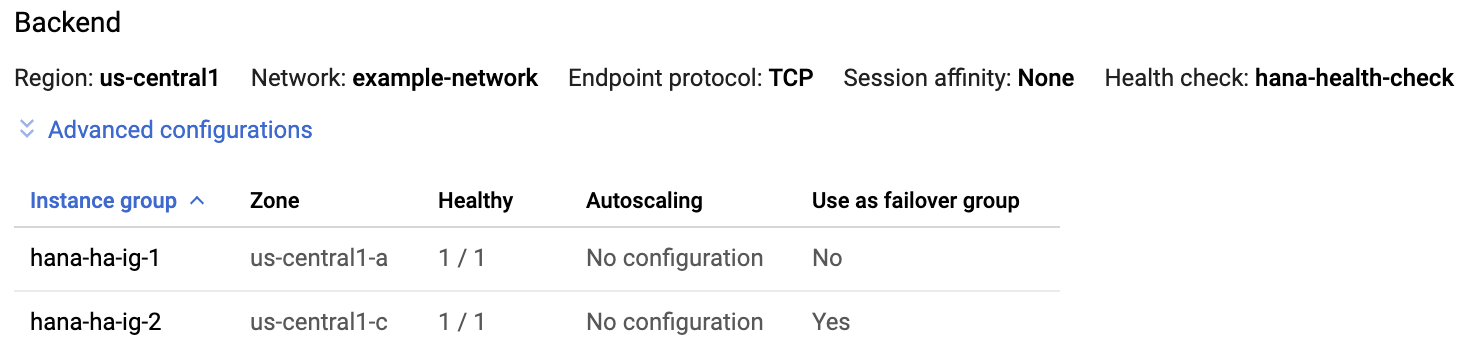
On each host, stop the HAProxy service:
#systemctl stop haproxy.serviceAfter you stop the HAProxy service on each host,
0/1displays in the Healthy column of each instance group.
Later, when the health check is configured, the cluster restarts the listener on the master node.
Create the health check resource
On either host as root, create a health check resource for the HAProxy service:
#pcs resource create healthcheck_resource_name service:haproxy op monitor interval=10s timeout=20sConfirm that the health check service is active on the same host as your master SAP HANA instance and VIP resource:
#pcs statusIf the health check resource is not on the primary host, move it with the following command:
#pcs resource move healthcheck_resource_name target_host_name#pcs resource clear healthcheck_resource_nameThe command
pcs resource clearleaves the resource at its new location but removes the unwanted location constraint that thepcs resource movecommand created.In the status, the resources section should look similar to the following example:
Full list of resources:

STONITH-example-ha-vm1   (stonith:fence_gce):    Started example-ha-vm2
STONITH-example-ha-vm2   (stonith:fence_gce):    Started example-ha-vm1
Clone Set: SAPHanaTopology_HA1_22-clone [SAPHanaTopology_HA1_22]
    Started: [ example-ha-vm1 example-ha-vm2 ]
Master/Slave Set: SAPHana_HA1_22-master [SAPHana_HA1_22]
    Masters: [ example-ha-vm1 ]
    Slaves: [ example-ha-vm2 ]
rsc_vip_HA1_22 (ocf::heartbeat:IPaddr2):       Started example-ha-vm1
rsc_healthcheck_HA1    (service:haproxy):      Started example-ha-vm2
Group the VIP and health check resources together:
#pcs resource group add rsc-group-name healthcheck_resource_name vip_resource_nameIn the cluster status, the resources section should look similar to the following example:
Full list of resources:

STONITH-example-ha-vm1   (stonith:fence_gce):    Started example-ha-vm2
STONITH-example-ha-vm2   (stonith:fence_gce):    Started example-ha-vm1
Clone Set: SAPHanaTopology_HA1_22-clone [SAPHanaTopology_HA1_22]
    Started: [ example-ha-vm1 example-ha-vm2 ]
Master/Slave Set: SAPHana_HA1_22-master [SAPHana_HA1_22]
    Masters: [ example-ha-vm1 ]
    Slaves: [ example-ha-vm2 ]
Resource Group: g-primary
    rsc_healthcheck_HA1        (service:haproxy):      Started example-ha-vm1
    rsc_vip_HA1_22     (ocf::heartbeat:IPaddr2):       Started example-ha-vm1
Create a constraint that locates the new group on the same node as the master SAP HANA instance.
RHEL 8 and later
#pcs constraint colocation add rsc-group-name with master sap_hana_resource_name-clone 4000RHEL 7
#pcs constraint colocation add rsc-group-name with master sap_hana_resource_name-master 4000Your final constraints should look similar to the following example:
# pcs constraint
Location Constraints:
 Resource: STONITH-example-ha-vm1
   Disabled on:
     Node: example-ha-vm1 (score:-INFINITY)
 Resource: STONITH-example-ha-vm2
   Disabled on:
     Node: example-ha-vm2 (score:-INFINITY)
Ordering Constraints:
 start SAPHanaTopology_HA1_22-clone then start SAPHana_HA1_22-master (kind:Mandatory) (non-symmetrical)
Colocation Constraints:
 g-primary with SAPHana_HA1_22-master (score:4000) (rsc-role:Started) (with-rsc-role:Master)
Ticket Constraints:
Test failover
Test your cluster by simulating a failure on the primary host. Use a test system or run the test on your production system before you release the system for use.
Backup the system before the test.
You can simulate a failure in a variety of ways, including:
HDB stopHDB killiptables ... DROPfor instances with multiple network interfacesecho c > /proc/sysrq-trigger
These instructions use iptables to simulate a
network disruption between your two hosts in the cluster. Use the ip link
command on an instance with a single network interface and use the iptables
command on instances with one or more network interfaces. The test validates
both failover as well as fencing. In the case where your instances have multiple
network interfaces defined, you use the iptables command on the secondary
host to drop incoming and outgoing traffic based on the IP used by the primary
host for cluster communication, thereby simulating a network connection loss to
the primary.
On the secondary host, as root, use the
iptablescommand to drop all incoming and outgoing network traffic to primary host.#iptables -A INPUT -s PRIMARY_CLUSTER_IP -j DROP; iptables -A OUTPUT -d PRIMARY_CLUSTER_IP -j DROPOnce the primary host is fenced and restarted, delete the added lines from iptable on secondary host to re-initiate the network traffic to primary host. Reconnect to either host by using SSH and change to the root user.
#iptables -D INPUT -s PRIMARY_CLUSTER_IP -j DROP; iptables -D OUTPUT -d PRIMARY_CLUSTER_IP -j DROPEnter
pcs statusto confirm that the primary host is now active on the VM that used to contain the secondary host. Automatic restart is enabled in the cluster, so the stopped host will restart and assume the role of secondary host, as shown in the following example.Cluster name: hana-ha-cluster Stack: corosync Current DC: hana-ha-vm-2 (version 1.1.19-8.el7_6.5-c3c624ea3d) - partition with quorum Last updated: Wed Jun 17 01:04:36 2020 Last change: Wed Jun 17 01:03:58 2020 by root via crm_attribute on hana-ha-vm-2 2 nodes configured 8 resources configured Online: [ hana-ha-vm-1 hana-ha-vm-2 ] Full list of resources: STONITH-hana-ha-vm-1 (stonith:fence_gce): Started hana-ha-vm-2 STONITH-hana-ha-vm-2 (stonith:fence_gce): Started hana-ha-vm-1 Clone Set: SAPHanaTopology_HA1_22-clone [SAPHanaTopology_HA1_22] Started: [ hana-ha-vm-1 hana-ha-vm-2 ] Master/Slave Set: SAPHana_HA1_22-master [SAPHana_HA1_22] Masters: [ hana-ha-vm-2 ] Slaves: [ hana-ha-vm-1 ] Resource Group: g-primary rsc_healthcheck_HA1 (service:haproxy): Started hana-ha-vm-2 rsc_vip_HA1_22 (ocf::heartbeat:IPaddr2): Started hana-ha-vm-2 Daemon Status: corosync: active/enabled pacemaker: active/enabled pcsd: active/enabled
Configure HANA Active/Active (Read Enabled)
Starting with SAP HANA 2.0 SPS1, you can configure HANA Active/Active (Read Enabled) in a Pacemaker cluster. This is optional.
To configure HANA Active/Active (Read Enabled) in a Pacemaker cluster, complete the following steps.
Configure the Cloud Load Balancing failover support for the secondary host
The internal passthrough Network Load Balancer service with failover support routes traffic to the secondary host in an SAP HANA cluster based on a health check service.
To configure failover support for the secondary host, follow these steps:
Open Cloud Shell:
Reserve an IP address for the virtual IP by running the following command.
The virtual IP (VIP) address follows the secondary SAP HANA system. This is the IP address that applications use to access your secondary SAP HANA system. The load balancer routes traffic that is sent to the VIP to the VM instance that currently hosts the secondary system.
If you omit the
--addressesflag in the following command, then an IP address in the specified subnet is chosen for you. For more information about reserving a static IP, see Reserving a static internal IP address.$gcloud compute addresses create secondary-vip-name \ --region cluster-region --subnet cluster-subnet \ --addresses secondary-vip-addressCreate a Compute Engine health check by running the following command.
For the port used by the health check, choose a port that is in the private range, 49152-65535, to avoid clashing with other services. The port should be different from the one configured for the health check used for the HANA primary system access. The check-interval and timeout values are slightly longer than the defaults so as to increase failover tolerance during Compute Engine live migration events. You can adjust the values if necessary.
$gcloud compute health-checks create tcp secondary-health-check-name \ --port=secondary-healthcheck-port-num \ --proxy-header=NONE --check-interval=10 --timeout=10 --unhealthy-threshold=2 \ --healthy-threshold=2Configure the load balancer and failover group by running the following commands.
Here you create an additional backend service and use the same instance groups that you created earlier for the backend service behind the Internal TCP/UDP Load Balancer for your SAP HANA primary system.
Create the load balancer backend service:
$gcloud compute backend-services create secondary-backend-service-name \ --load-balancing-scheme internal \ --health-checks secondary-health-check-name \ --no-connection-drain-on-failover \ --drop-traffic-if-unhealthy \ --failover-ratio 1.0 \ --region cluster-region \ --global-health-checksAdd the primary instance group to the backend service:
$gcloud compute backend-services add-backend secondary-backend-service-name \ --instance-group primary-ig-name \ --instance-group-zone primary-zone \ --region cluster-regionAdd the secondary, failover instance group to the backend service:
$gcloud compute backend-services add-backend secondary-backend-service-name \ --instance-group secondary-ig-name \ --instance-group-zone secondary-zone \ --failover \ --region cluster-regionCreate a forwarding rule.
For the IP address flag, specify the IP address that you reserved for the VIP. If you need to access the HANA secondary system from outside of the region that you specify in the following command, then include the flag
--allow-global-accessin the forwarding rule's definition.$gcloud compute forwarding-rules create secondary-rule-name \ --load-balancing-scheme internal \ --address secondary-vip-name \ --subnet cluster-subnet \ --region cluster-region \ --backend-service secondary-backend-service-name \ --ports ALLFor more information about cross-region access to your SAP HANA high-availability system, see Internal TCP/UDP Load Balancing.
Enable HANA Active/Active (Read Enabled)
On your secondary host, enable Active/Active (read enabled) for SAP HANA system replication by following these steps:
As root, place the cluster in maintenance mode:
$pcs property set maintenance-mode=trueAs
SID_LCadm, stop SAP HANA:>HDB stopAs
SID_LCadm, re-register the HANA secondary system with SAP HANA system replication using the operation modelogreplay_readaccess:>hdbnsutil -sr_register --remoteHost=primary-host-name --remoteInstance=inst_num \ --replicationMode=syncmem --operationMode=logreplay_readaccess --name=secondary-host-nameAs
SID_LCadm, start SAP HANA:>HDB startAs
SID_LCadm, confirm that HANA synchronization status isACTIVE:>cdpy; python systemReplicationStatus.py --sapcontrol=1 | grep overall_replication_statusYou should see an output similar to the following example:
overall_replication_status=ACTIVE
Configure Pacemaker
Configure your Pacemaker HA cluster for Active/Active (read enabled) by running the following commands as root:
Set up listeners for the health checks:
Copy and rename the default
haproxy.serviceconfiguration file to make it into a template file for the multiple haproxy instances:# cp /usr/lib/systemd/system/haproxy.service \ /etc/systemd/system/haproxy@.serviceEdit the [Unit] and [Service] sections of the haproxy@.service file to include the %i instance parameter, as shown in the following example:
RHEL 7
[Unit]
Description=HAProxy Load Balancer %i
After=network-online.target

[Service]
EnvironmentFile=/etc/sysconfig/haproxy
ExecStart=/usr/sbin/haproxy-systemd-wrapper -f /etc/haproxy/haproxy-%i.cfg -p /run/haproxy-%i.pid $OPTIONS
...
RHEL 8
[Unit]
Description=HAProxy Load Balancer %i
After=network-online.target
Wants=network-online.target

[Service]
Environment="CONFIG=/etc/haproxy/haproxy-%i.cfg" "PIDFILE=/run/haproxy-%i.pid"
...
For more information from Red Hat about
systemdunit templates, see Working with instantiated units.Create an
haproxy.cfgconfiguration file for your SAP HANA primary system. For example:#vi /etc/haproxy/haproxy-primary.cfgIn the
haproxy-primary.cfgconfiguration file for your SAP HANA primary system, insert the following configuration and replacehealthcheck-port-numwith the port number that you specified when you created the Compute Engine healthcheck for the HANA primary system earlier:global chroot /var/lib/haproxy pidfile /var/run/haproxy-%i.pid user haproxy group haproxy daemon defaults mode tcp log global option dontlognull option redispatch retries 3 timeout queue 1m timeout connect 10s timeout client 1m timeout server 1m timeout check 10s maxconn 3000 # Listener for SAP healthcheck listen healthcheck bind *:healthcheck-port-num
Create an
haproxy.cfgconfiguration file for yor SAP HANA secondary system. For example:#vi /etc/haproxy/haproxy-secondary.cfgIn the
haproxy-secondary.cfgconfiguration file for your SAP HANA secondary system, insert the following configuration and replacesecondary-healthcheck-port-numwith the port number that you specified when you created the Compute Engine healthcheck for the HANA secondary system earlier:global chroot /var/lib/haproxy pidfile /var/run/haproxy-%i.pid user haproxy group haproxy daemon defaults mode tcp log global option dontlognull option redispatch retries 3 timeout queue 1m timeout connect 10s timeout client 1m timeout server 1m timeout check 10s maxconn 3000 # Listener for SAP healthcheck listen healthcheck bind *:secondary-healthcheck-port-num
Remove the existing listener configuration from
/etc/haproxy/haproxy.cfg:#--------------------------------------------------------------------- # Health check listener port for SAP HANA HA cluster #--------------------------------------------------------------------- listen healthcheck bind *:healthcheck-port-num
Reload the
systemdservices to load the changes:#systemctl daemon-reloadConfirm that the two haproxy services are set up correctly:
#systemctl start haproxy@primary#systemctl start haproxy@secondary#systemctl status haproxy@primary#systemctl status haproxy@secondaryThe returned status should show the
haproxy@primary.serviceandhaproxy@secondary.serviceasactive (running). The following is an example output forhaproxy@primary.service:● haproxy@primary.service - Cluster Controlled haproxy@primary Loaded: loaded (/etc/systemd/system/haproxy@.service; disabled; vendor preset: disabled) Drop-In: /run/systemd/system/haproxy@primary.service.d └─50-pacemaker.conf Active: active (running) since Fri 2022-10-07 23:36:09 UTC; 1h 13min ago Main PID: 21064 (haproxy-systemd) CGroup: /system.slice/system-haproxy.slice/haproxy@primary.service ├─21064 /usr/sbin/haproxy-systemd-wrapper -f /etc/haproxy/haproxy-primary.cfg -p /run/hapro... ├─21066 /usr/sbin/haproxy -f /etc/haproxy/haproxy-primary.cfg -p /run/haproxy-primary.pid -... └─21067 /usr/sbin/haproxy -f /etc/haproxy/haproxy-primary.cfg -p /run/haproxy-primary.pid -... Oct 07 23:36:09 hana-ha-vm-1 systemd[1]: Started Cluster Controlled haproxy@primary.In Cloud Shell, after waiting a few seconds for the health check to detect the listener, check the health of your backend instance groups in both the primary and secondary backend services:
$gcloud compute backend-services get-health backend-service-name \ --region cluster-region$gcloud compute backend-services get-health secondary-backend-service-name \ --region cluster-regionYou should see an output similar to the following showing the VM you are currently working on, the
healthStateisHEALTHY:--- backend: https://www.googleapis.com/compute/v1/projects/example-project-123456/zones/us-central1-a/instanceGroups/hana-ha-ig-1 status: healthStatus: ‐ healthState: HEALTHY instance: https://www.googleapis.com/compute/v1/projects/example-project-123456/zones/us-central1-a/instances/hana-ha-vm-1 ipAddress: 10.0.0.35 port: 80 kind: compute#backendServiceGroupHealth
Stop both services to let Pacemaker manage the services:
#systemctl stop haproxy@primary#systemctl stop haproxy@secondaryRepeat the preceding steps on each host in the cluster.
Create a local cluster IP resource for the VIP address that you reserved for the secondary system:
#pcs resource create secondary_vip_resource_name \ IPaddr2 ip="secondary-vip-address" nic=lo cidr_netmask=32 \ op monitor interval=3600s timeout=60sSet up the helper health-check service by running the following commands.
The load balancer uses a listener on the health-check port of each host to determine where the secondary instance of the SAP HANA cluster is running.
To manage the listeners in the cluster, you create a resource for the listener:
Delete the resource for the health check service for the HANA primary system:
#pcs resource delete healthcheck_resource_name --forceAdd a new resource for the health check service for the HANA primary system:
#pcs resource create primary_healthcheck_resource_name \ service:haproxy@primary op monitor interval=10s timeout=20sAdd a new resource for the health check service for the HANA secondary system:
#pcs resource create secondary_healthcheck_resource_name \ service:haproxy@secondary op monitor interval=10s timeout=20s
Group the VIP and the helper health check service resources
Add the new health check resource to the existing resource group for primary VIP resources:
#pcs resource group add rsc-group-name primary_healthcheck_resource_name \ --before vip_resource_nameAdd a new resource group to group the VIP and helper health check service resources for the HANA secondary system:
#pcs resource group add secondary-rsc-group-name \ secondary_healthcheck_resource_name secondary_vip_resource_name
Create two location constraints by running the following commands:
These constraints are to ensure that the secondary VIP resource group is placed on the correct cluster node:
#pcs constraint location secondary-rsc-group-name rule score=INFINITY \ hana_sid_sync_state eq SOK and hana_sid_roles eq 4:S:master1:master:worker:master#pcs constraint location secondary-rsc-group-name rule score=2000 \ hana_sid_sync_state eq PRIM and hana_sid_roles eq 4:P:master1:master:worker:masterExit cluster maintenance mode:
#pcs property set maintenance-mode=falseCheck the status of the cluster:
#pcs statusThe following examples shows the status of an active, properly configured cluster for SAP HANA system replication with Active/Active (read enabled). You should see an additional resource group for the secondary system's VIP resources. In the following example, the name of that resource group is
g-secondary.Cluster name: hacluster Stack: corosync Current DC: hana-ha-vm-1 (version 1.1.23-1.el7_9.1-9acf116022) - partition with quorum Last updated: Sat Oct 8 00:37:08 2022 Last change: Sat Oct 8 00:36:57 2022 by root via crm_attribute on hana-test-2 2 nodes configured 10 resource instances configured Online: [ hana-ha-vm-1 hana-ha-vm-2 ] Full list of resources: STONITH-hana-ha-vm-1 (stonith:fence_gce): Started hana-ha-vm-2 STONITH-hana-ha-vm-2 (stonith:fence_gce): Started hana-ha-vm-1 Resource Group: g-primary rsc_healthcheck_HA1-primary (service:haproxy@primary): Started hana-ha-vm-1 rsc_vip_HA1_00 (ocf::heartbeat:IPaddr2): Started hana-ha-vm-1 Clone Set: SAPHanaTopology_HA1_00-clone [SAPHanaTopology_HA1_00] Started: [ hana-ha-vm-1 hana-ha-vm-2 ] Master/Slave Set: SAPHana_HA1_00-master [SAPHana_HA1_00] Masters: [ hana-ha-vm-1 ] Slaves: [ hana-ha-vm-2 ] Clone Set: msl_SAPHana_HA1_HDB00 [rsc_SAPHana_HA1_HDB00] (promotable): Masters: [ hana-ha-vm-1 ] Slaves: [ hana-ha-vm-2 ] Resource Group: g-secondary rsc_healthcheck_HA1-secondary (service:haproxy@secondary): Started hana-ha-vm-2 rsc_vip_HA1_00-secondary (ocf::heartbeat:IPaddr2): Started hana-ha-vm-2
Troubleshoot
To troubleshoot problems with high-availability configurations for SAP HANA on RHEL, see Troubleshooting high-availability configurations for SAP.
Get support for SAP HANA on RHEL
For issues with Google Cloud infrastructure or services, contact Customer Care. You can find the contact information on the Support Overview page in the Google Cloud console. If Customer Care determines that a problem resides in your SAP systems, then you are referred to SAP Support.
For SAP product-related issues, log your support request with
SAP support.
SAP evaluates the support ticket and, if it appears to be a Google Cloud
infrastructure issue, then SAP transfers that ticket to the appropriate
Google Cloud component in its system: BC-OP-LNX-GOOGLE or
BC-OP-NT-GOOGLE.
Support requirements
Before you can receive support for the SAP systems and the Google Cloud resources that you're using to run them, you must meet the minimum support plan requirements.
For more information about the minimum support requirements for SAP on Google Cloud, see:
- Getting support for SAP on Google Cloud
- SAP Note 2456406 - SAP on Google Cloud Platform: Support Prerequisites (An SAP user account is required)
Gather diagnostic information
If you need help resolving a problem with high-availability clusters for SAP HANA on RHEL, gather the required diagnostic information and contact Cloud Customer Care. For more information, see High-availability clusters on RHEL diagnostic information.
Connect to SAP HANA
If the host VMs don't have an external IP address for SAP HANA, you can only connect to the SAP HANA instances through the bastion instance using SSH or through the Windows server through SAP HANA Studio.
- To connect to SAP HANA through the bastion instance, connect to the bastion host, and then to the SAP HANA instance(s) by using an SSH client of your choice.
- To connect to the SAP HANA database through SAP HANA Studio, use a remote desktop client to connect to the Windows Server instance. After connection, manually install SAP HANA Studio and access your SAP HANA database.
Perform post-deployment tasks
After you successfully deploy your SAP HANA scale-up system in an HA cluster on RHEL, complete the following steps:
Change the temporary passwords for the SAP HANA system administrator and database superuser. For example:
sudo passwd SID_LCadm
For information from SAP about changing the password, see Reset the
SYSTEMUser Password of the System Database.Before using your SAP HANA instance, configure and backup your new SAP HANA database.
If your SAP HANA system is deployed on a VirtIO network interface, then we recommend that you ensure the value of the TCP parameter
/proc/sys/net/ipv4/tcp_limit_output_bytesis set to1048576. This modification helps improve the overall network throughput on the VirtIO network interface without affecting the network latency.
For more information, see:
What's next
- Explore the SAP HANA disaster recovery planning guide.
- Set up monitoring for your SAP HANA system by using the Google Cloud's Agent for SAP. For more information, see Monitoring SAP HANA using Google Cloud.
- Automate continuous validation checks for your SAP HANA HA workload by using the evaluation service of Workload Manager. For more information, see About Workload Manager evaluation.